



Under the leadership of the Party, with its democratic and scientific methods and approaches to governance, constantly innovated to suit the requirements and tasks of each period, the Vietnamese revolutionary cause in general, and the reform cause in particular, has achieved many miracles and great accomplishments.
However, General Secretary To Lam frankly acknowledged that the reform of the Party's leadership methods still has many shortcomings and limitations.

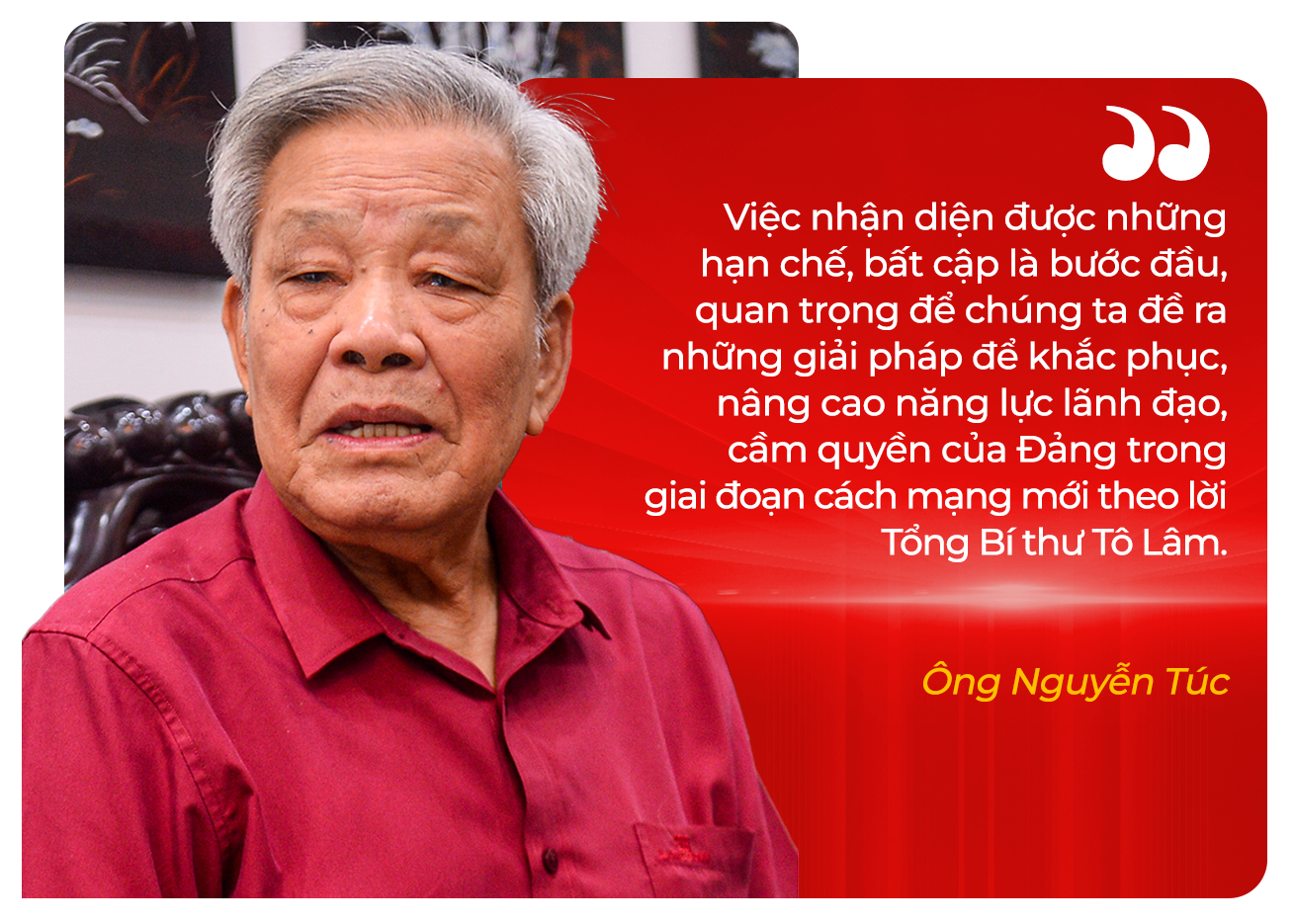
Mr. Nguyen Tuc, a member of the Presidium of the Central Committee of the Vietnam Fatherland Front, believes that the five shortcomings and limitations regarding the Party's leadership and governance methods mentioned by General Secretary To Lam are very relevant and practical, directly addressing the reality rather than just rhetoric.
Firstly, there is still a situation where many documents are issued, some of which are vague, scattered, overlapping, and slow to be supplemented, amended, or replaced.
Mr. Tuc pointed out that, in reality, resolutions and documents from the Party, from the central to local levels, have been very long but too general. Many resolutions are dozens of A4 pages long, with rambling content, lacking focus and key points, and far removed from reality.
"This makes it difficult for Party committees and authorities to understand and implement. Many Party committees implement resolutions from higher levels but fail to quantify them appropriately to the characteristics of their respective sectors and localities, leading to confusion and numerous difficulties in implementation.", Mr. Tuc said.
Secondly, some major policies and guidelines of the Party have not been institutionalized in a timely and complete manner, or have been institutionalized but their feasibility is not high.
Mr. Tuc emphasized that all policies and guidelines of the Party, and policies and laws of the State must stem from the demands of reality, from the legitimate needs and aspirations of the people, as President Ho Chi Minh reminded cadres and Party members to always bear in mind:Leadership in all practical work of the Party must originate from the masses and return to the masses.".
However, according to Mr. Tuc, there are still shortcomings in the Party's policy and guidelines, and in the State's laws and regulations, compared to these requirements.
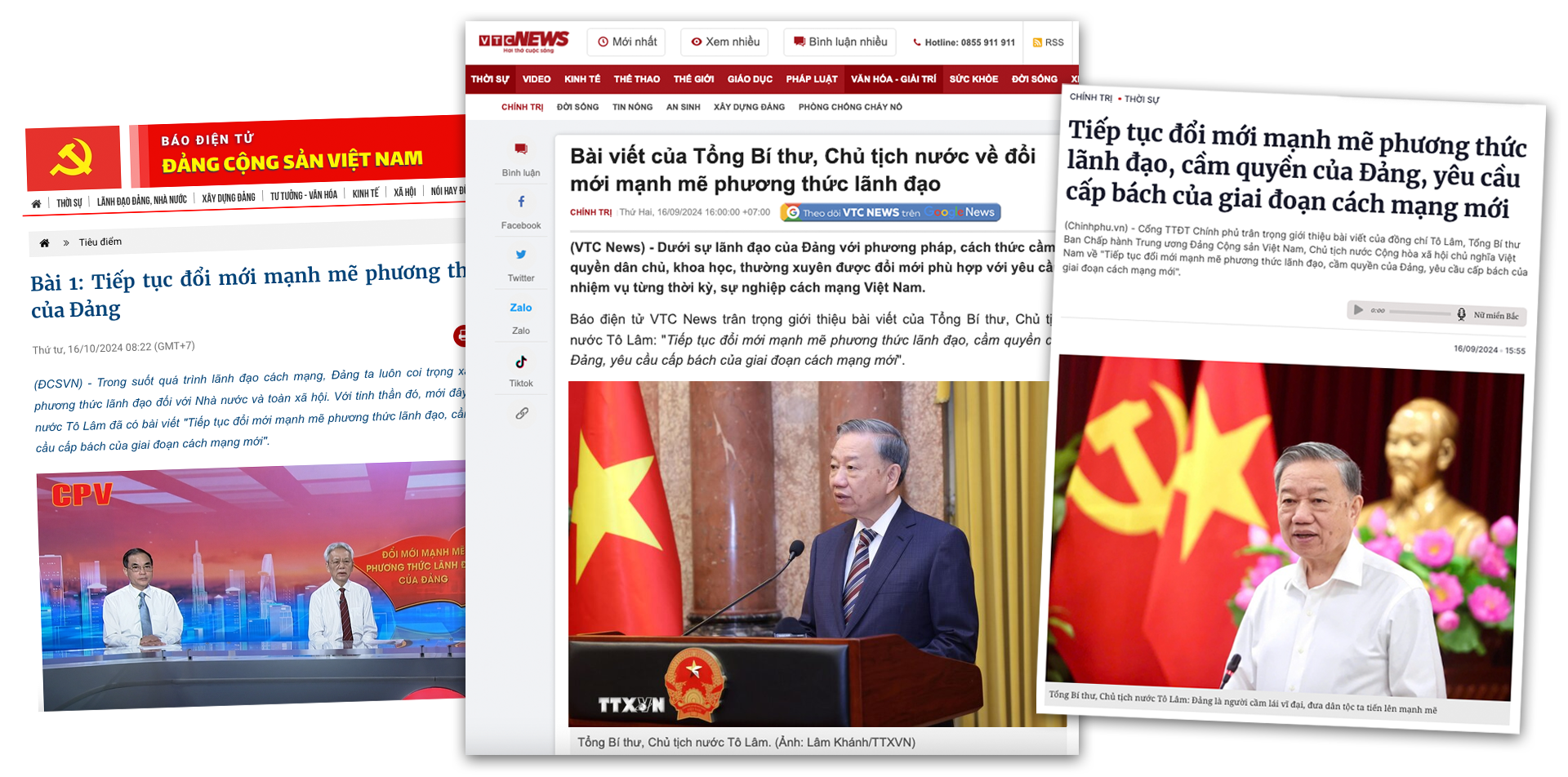
The directive on reforming the Party's leadership and governance methods was widely disseminated in the press and thoroughly communicated to every Party branch and every Party member.
In reality, throughout the Party's leadership, some policies have been issued based on the subjective perceptions and desires of state management agencies, while the participation, suggestions, and feedback from citizens and businesses as beneficiaries and those affected by these policies have been very limited.
"This leads to situations of "group interests," "local interests," and "playing both sides," resulting in policies that are implemented ineffectively and without much success. Furthermore, some draft laws submitted to the National Assembly for discussion have failed to generate high levels of consensus and agreement.", Mr. Tuc analyzed.
Thirdly, the overall model of the political system is incomplete; the functions, tasks, powers, and working relationships of organizations, individuals, and leaders are not clearly defined; and decentralization and delegation of power are not strong enough.
A member of the Presidium of the Central Committee of the Vietnam Fatherland Front stated that the overall model of Vietnam's political system includes the constituent parts of the Party, the State, the Vietnam Fatherland Front, and other political and social organizations.
Despite being implemented vigorously with high political determination and achieving noteworthy initial results, practice has also revealed shortcomings and limitations in the organizational structure of our country's political system.
Mr. Tuc observed that the functions, tasks, authority, and methods of organization and operation between the Party, the State, and people's organizations and associations are not yet clearly defined, and there is still overlap and duplication. The organizational structure of institutions within the political system is still cumbersome, with many layers and points of contact.
"Another thing we can see is that the organizational structure of the political system has not met the requirements of the reform process and has not kept pace with the changes in socio-economic development.", he said.
Fourth, the organizational model of the Party and the political system still has shortcomings, making it difficult to distinguish between leadership and management, easily leading to excuses, taking over responsibilities, or neglecting the Party's leadership role.
According to Mr. Nguyen Tuc, the Communist Party of Vietnam has led the revolutionary cause for over 94 years, including more than 79 years in power. However, the concept of a ruling party, its content, and its methods of governance still seem to be misunderstood.
"Therefore, there is still a tendency to excuse and take over the responsibilities when leaders take on too much, doing all the work of managers, or when managers do everything themselves, neglecting leadership. In our country's system, the Party leads, the State manages, and the people are the masters. Over time, contradictions, overlaps, and confusion have persisted, reducing the effectiveness of leadership and management in general.", Mr. Tuc assessed.
And the fifth limitation, as pointed out by General Secretary To Lam, is that administrative reform and the renewal of working styles and methods within the Party are still slow; meetings are still too frequent.
Mr. Nguyen Tuc stated that these limitations and shortcomings significantly affect the Party's leadership and governance capacity and effectiveness, impacting socio-economic development, the Party's prestige, and the people's trust in the Party.

Regarding institutional issues, at the 10th Conference of the Central Committee of the Communist Party of Vietnam, 13th term, General Secretary To Lam identified it as a strategic breakthrough for the next term and presented his views for the Central Committee to discuss.
After discussion, the Central Executive Committee unanimously determined:Regarding strategic breakthroughs, there was a high degree of consensus on identifying stronger breakthroughs in development institutions, removing bottlenecks and barriers, and placing people and businesses at the center...".
At the opening session of the 8th Session of the 15th National Assembly, General Secretary To Lam delivered a short, concise, but very decisive speech. He further pointed out:Of the three biggest bottlenecks today—institutions, infrastructure, and human resources—institutions are the bottleneck of the bottlenecks.".
This illustrates that, alongside changes in the Party's leadership and governance methods, the National Assembly, with its functions, also needs to clearly recognize and reflect these changes in its legislative, supervisory, and decision-making processes on important national issues.
Also in his opening speech on October 21st, the Party leader outlined important directives to remove institutional bottlenecks from the Government to the localities.
Dr. Nguyen Van Dang, a researcher in Public Administration and Policy (Ho Chi Minh National Political Academy), commented that since the 11th Party Congress, institutional reform has been identified as one of the three strategic breakthrough priorities.
This means that the Party recognizes the importance of perfecting the institutional system in a modern direction in order to create favorable conditions for socio-economic development.
"Institutions are an abstract concept, referring to many forms of existence in reality, both formal such as laws and informal such as customs, traditions, and social norms.", Mr. Dang said.
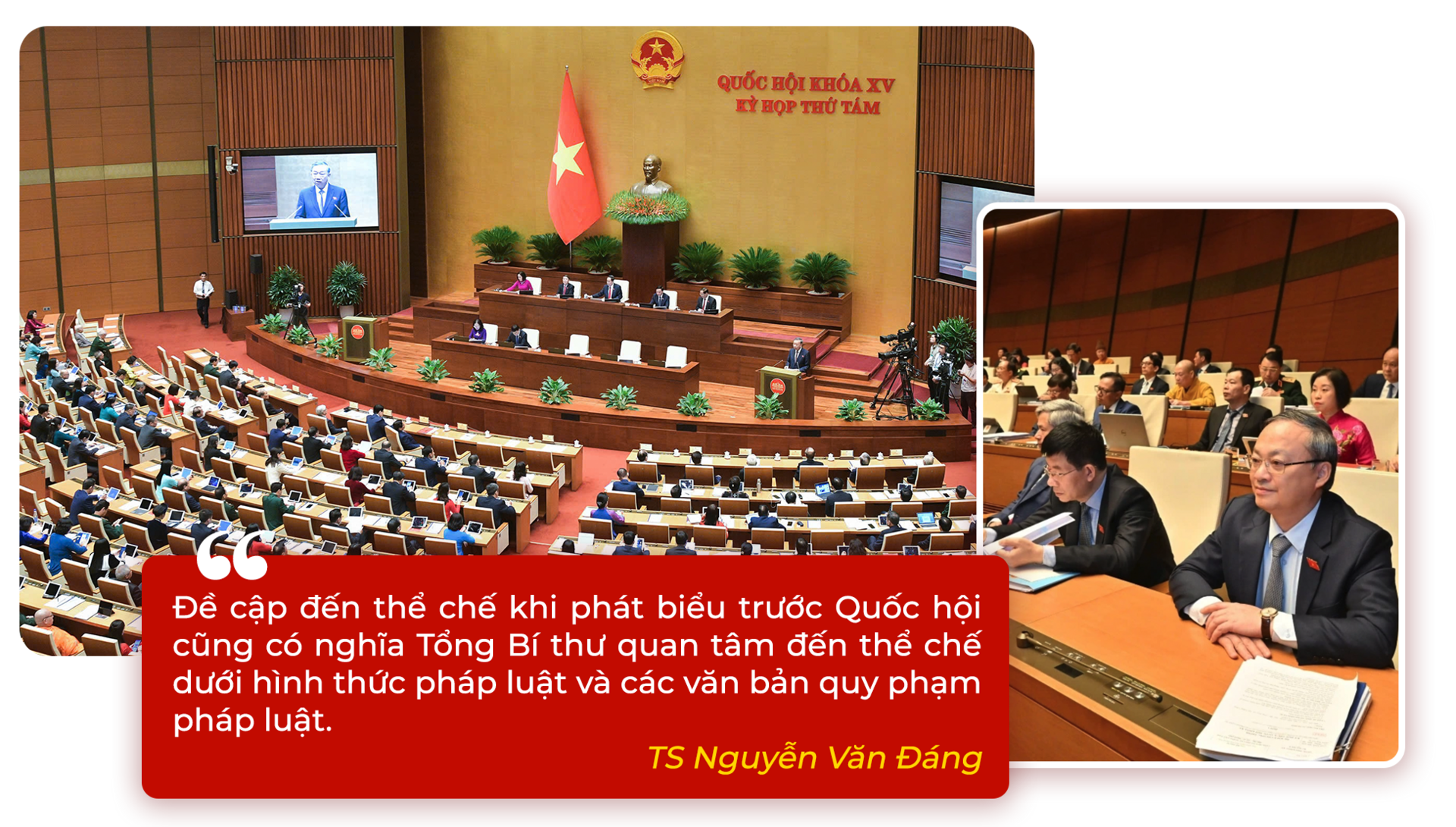
According to Mr. Dang, the General Secretary's assertion that institutions are the "bottleneck" of "bottlenecks" means he wants to emphasize the special importance of removing legal and administrative barriers that are no longer relevant to the dynamics of daily life.
At the same time, the legislature must also closely follow the needs arising from practice to quickly enact new institutional regulations to help the public administration operate flexibly, meet the increasingly diverse needs of society, and create a more favorable environment for business operations and people's lives.
Dr. Nguyen Van Dang expressed his impression that in his speech before the National Assembly, General Secretary To Lam gave very decisive directives such as the need to resolutely abandon the "if you can't manage it, ban it" mentality; laws should only regulate framework issues and matters of principle; laws should not be too long; decentralization and delegation of power must be promoted with the motto "local authorities decide, local authorities do, local authorities are responsible"; and it is necessary to proactively, actively, and urgently build a legal framework for new issues and trends…
He argued that the aforementioned viewpoints demonstrate that the Party and State leaders clearly recognize the importance of institutional conditions for the country's development.
"If we can successfully modernize the institutional system according to the above directions, it will make a decisive contribution to changing the nature of state management towards a development-oriented approach, that is, encouraging creativity, unleashing all productive forces, and activating all resources for development.", Dr. Nguyen Van Dang observed.

Dr. Cu Van Trung, a specialist in Political Science, stated that, along with emphasizing the phrase "continuing strong reforms," in his article, the General Secretary reiterated the teachings of VI Lenin:When circumstances have changed and we have to tackle a different kind of task, we shouldn't look back and use the methods of yesterday.".
Mr. Trung stated that the Party is implementing reforms in leadership methods step by step, in stages, and with lessons learned and summaries. Most recently, at the 6th Central Committee Meeting of the 13th Party Congress (October 2022), the Central Committee summarized 15 years of implementing Resolution No. 5 of the 10th Party Congress on continuing to reform the Party's leadership methods over the political system.
And the 6th Central Committee Conference of the 13th Party Congress issued Resolution No. 28 on continuing to innovate the Party's leadership and governance methods over the political system in the new period.
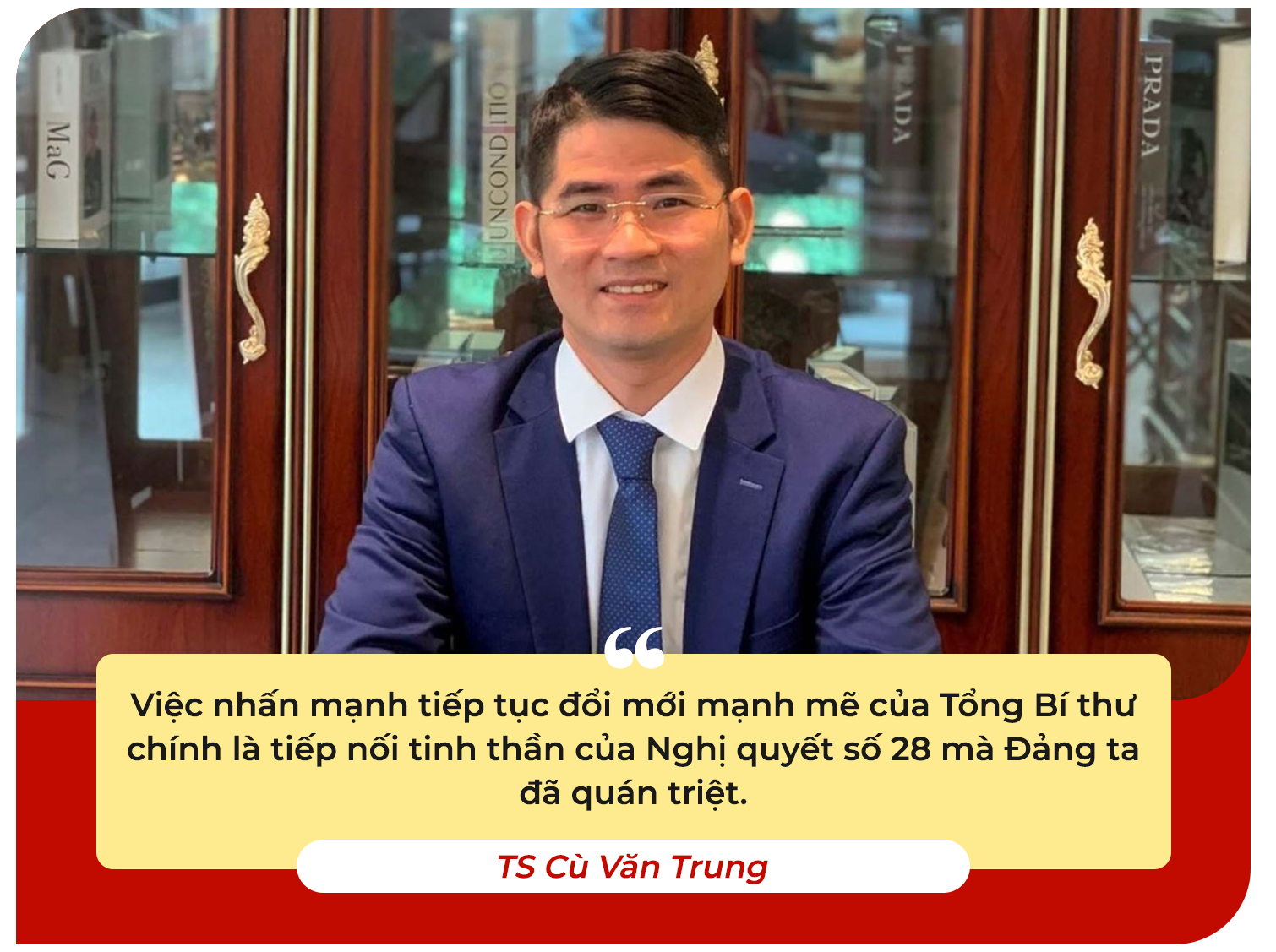
The expert analyzed that, compared to Resolution No. 5 of the 10th Central Committee, Resolution No. 28 adds the phrase "in power" to suit the new stage of the revolution.
Accordingly, leadership and governance have a dialectical relationship; effective leadership will help to strengthen and enhance the ruling position of the Party. The Party's governing capacity is also enhanced through the process of leading the State and society in successfully concretizing the policies, guidelines, programs, and resolutions of the ruling Party.
Furthermore, according to Mr. Trung, leadership is a function that runs throughout the Party's existence, but the position and function of governing only come when the Party seizes power. In the current context of having become a firmly established ruling party, good leadership is essential for good governance. The Communist Party of Vietnam clearly understands the content and methods of governance, and has therefore determined appropriate leadership methods and approaches.
"I believe that, building on the successes of the Party's leadership and governance over the past period, the issue of continuing to vigorously innovate the Party's methods of governance will be thoroughly understood and deeply grasped, creating many positive changes not only in the political system and the state apparatus but also contributing to the success of the cause of building and defending the socialist Vietnamese Fatherland in the future."Dr. Cu Van Trung affirmed.
Referring further to the inheritance of Resolution No. 28 in General Secretary To Lam's article, Mr. Trung noted that the Party leader emphasized the decentralization of inspection and supervision authority, coupled with the detection and strict handling of all acts of abusing inspection and supervision for corruption and negative practices.
Mr. Trung argued that controlling power, decentralization, delegation of authority, and clear accountability of leaders are all favorable factors that help officials and Party members demonstrate their abilities and creativity in their work. The division of labor, coordination, and mutual control overcome the abuse of power and corruption by some leading and managerial officials.
"The widespread and institutionalized mindset that "state agencies are allowed to do what the law permits, and citizens are allowed to do what the law does not prohibit" will overcome the concentration of power, eliminate "petty tyrants," and prevent the dominance and manipulation of government agencies by vested interests. From there, the mindset and awareness of officials and Party members will be motivated to strive and contribute, and will have faith in the cause they pursue, enabling them to wholeheartedly serve the country and the people.", said Dr. Cu Van Trung.


 Comment