Paranung – the soul of the festival, the sound of the drum has even been featured in a famous song by composer Tran Tien. Delving deeper, I discovered many interesting things surrounding this legendary drum.
Video: Artisan Han Quan and his journey to "keep the flame" of Paranung alive.
Paranung - The drumbeat that soothes the heart
Pa ra Paranung!
Oh, the sound of the drums soothes my heart.
Gently lull the boat to sleep.
Vast, deserted riverbank
I love the sound of your singing.
I love Paranung!
Composer Tran Tien once recounted that he wrote the song "The Sound of the Paranung Drum" around 1984, praising Cham culture with its Mat'ra scarf, Atidza singing, and the legendary sound of the Paranung drum. The land of the Cham people in Ninh Thuan was formerly called Panduranga.
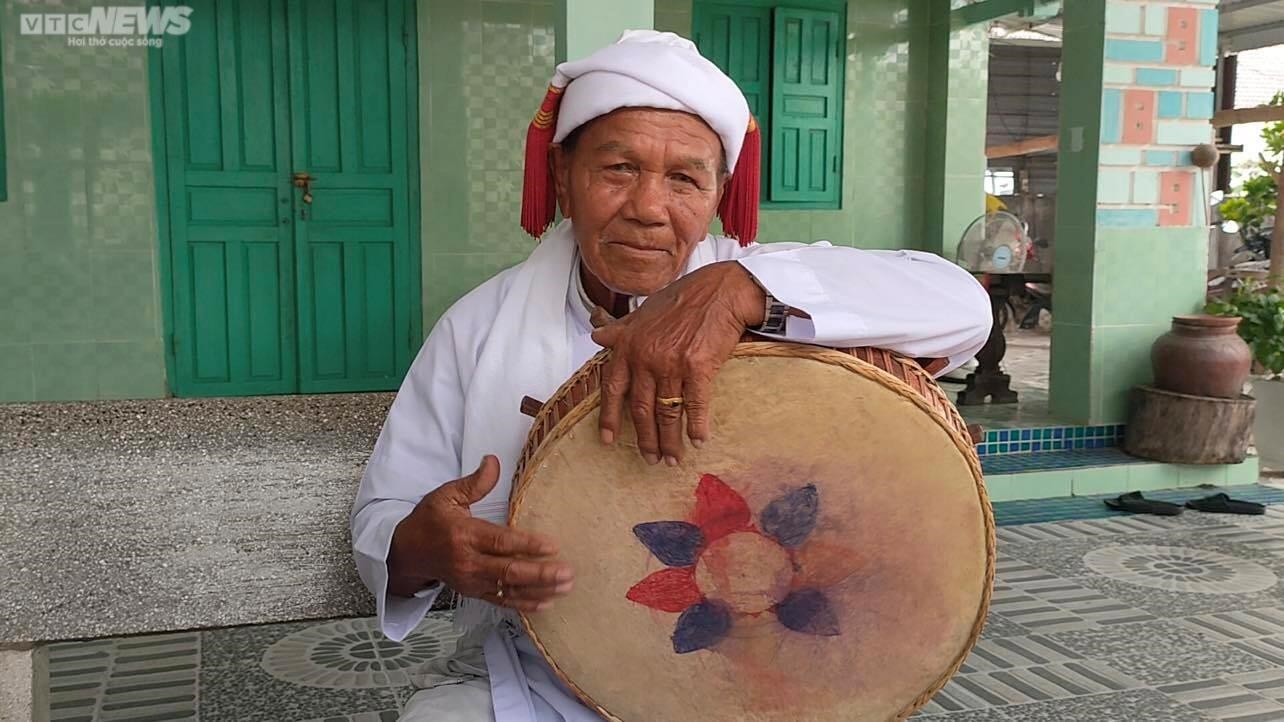
Mr. Han Quan (74 years old, residing in Tan Duc village, Phuoc Huu commune, Ninh Phuoc district) is considered a "treasure" of traditional Cham musical instruments. He is not only a Maduen (Mu Tun - a folk ritual priest serving at festivals), but also a skilled craftsman and performer of most traditional Cham musical instruments, including the Paranung drum.
Visiting artisan Han Quan on a rainy afternoon in mid-June, from afar we could hear the sounds of the Paranung and Ghinang drums, sometimes slow and gentle, sometimes lively and boisterous, echoing throughout the small village.
Over a warm cup of tea, artisan Han Quan recounted that since childhood, he had always happily watched the elders in his village perform the Paranung drumming during the Katê festival. Each time he watched a performance, seeing the artisans play the drums, he longed to play himself. He then approached the drum shops, asked to try playing, and requested to be taught.
In the beginning, the sound produced was just a dry, clumsy drum beat. But with persistent practice, as Han Quan's hands became calloused, many began to admire the "soulful" sound of the young Cham man's drumming.
According to the elderly artisan, the Saranai horn, Paranung drum, and Ghinang drum are an indispensable trio of musical instruments that form the soul of Cham religious activities and festivals, symbolizing humanity and the universe in miniature. The Paranung drum is considered a symbol of the chest, representing the human heart. The Saranai horn is the head, and the Ghinang drum is the foot. These three instruments are inseparable but always blend together.
Paranung drummers are called "master clappers" because, during performances, the drum is placed in front of the stomach, and the fingers of both hands are used to clap (instead of drumsticks) on different points on the drumhead, creating colored sounds: tin, tin, tac.
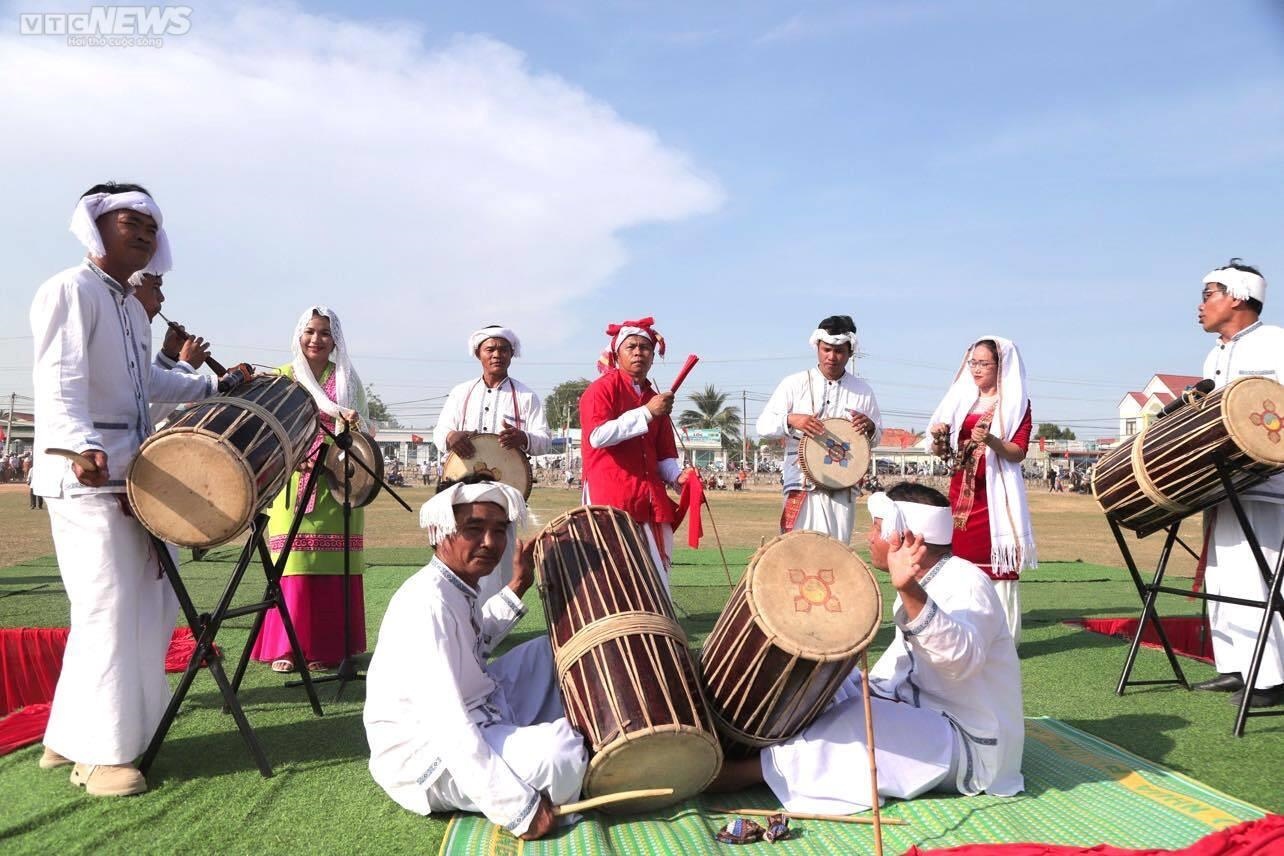
The Paranung drum is the totem of the shaman in folk religious rituals and festivals.
The Paranung drum is present in the Rija Nagar ceremony to pray for favorable weather, bountiful harvests, and a prosperous and happy life for the villagers. It is indispensable in the Katê festival commemorating the gods, or the Kud ceremony (the ceremony of choosing a plot of land to build a house).
Paranung creates lively Theimai dances to celebrate the couple's wedding day...
"The Paranung drum is the totem of shamans in folk religious rituals and festivals. Along with the Ghinang drum and the Saranai horn, whatever melody the Paranung drum plays, the other instruments harmonize, creating a lively, vibrant, yet shimmering and mystical chord. This trio of instruments is always present in religious rituals and festivals, inseparable from one another."Artisan Han Quan shared.
The music played on the Paranung drums must follow certain rules and melodies. The length of a Paranung drum piece depends on the dance of the festival. Only with a pure heart can the drumming be soulful.
"The Paranung drum, like the Ghinang drum and Saranai horn, comprises 72 musical pieces, representing the names of 72 deities in Cham cultural beliefs. Each ritual or festival features a different piece of music, considered as praise from descendants to the gods."The artisan Han Quan said.
Now, the elderly artisan travels across the sun-drenched, white-sand region to perform at festivals, bringing the traditional Paranung drumming to villages near and far.
The secret to having a good drum.
Besides performing skillfully, artisan Han Quan is also famous for crafting most Cham musical instruments, including the Paranung drum.
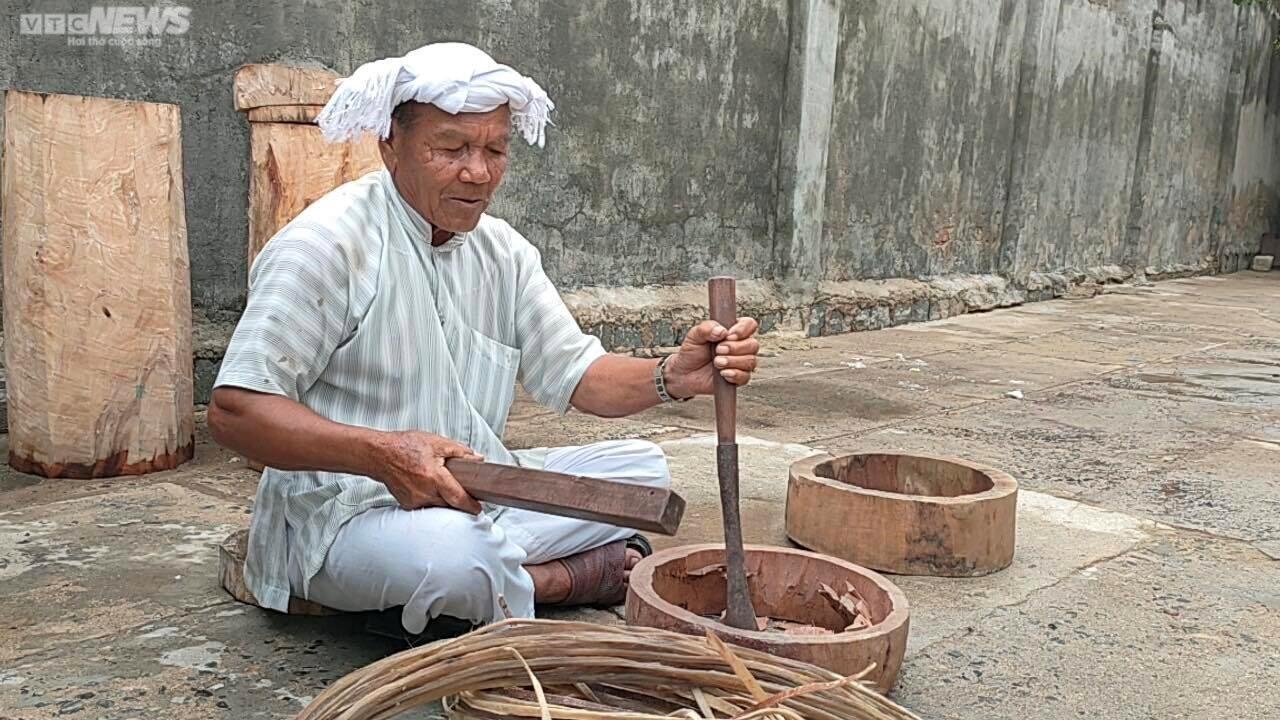
Making a Paranung drum requires considerable effort, usually taking a month and involving many steps.
Turning the Paranung drum in his hands, artisan Han Quan shared that the Paranung is a round drum with three main sounds: tac, tam, and tam.
The Paranung drum has only one drumhead. However, making a Paranung drum requires considerable effort, usually a month, involving many steps, from selecting the wood and leather, drying them, and precisely timing the stretching of the drumhead to produce a pair of drums with a beautiful sound. The drums are made in male-female pairs, representing yin and yang, reflecting the cultural and religious beliefs of the Cham people.
First, the craftsman must order a piece of ironwood or jackfruit wood with a diameter of 45-50 cm and a height of 12 cm. Then, they hollow out the wood to leave the drum body, which should be 4-5 cm thick. When finished, the drum body is round and about 1,5-2 cm thick. Drums produce the best sound when made from naturally hollowed-out driftwood, combined with straps and a drumhead made of young buffalo hide, but this type of wood is very difficult to find.
The drumhead is covered with young buffalo hide or goatskin. To tighten the drumhead, the craftsman uses 70-80 rattan knots threaded through the hide, pulling it taut, and then securing 12 wooden pegs (each about 8cm long and 1cm thick) made of Cà Chít wood to a bamboo ring at the back of the drumhead. These pegs serve both to tighten the drumhead and to adjust the sound. The pegs are larger at the corners and gradually smaller towards the tip.
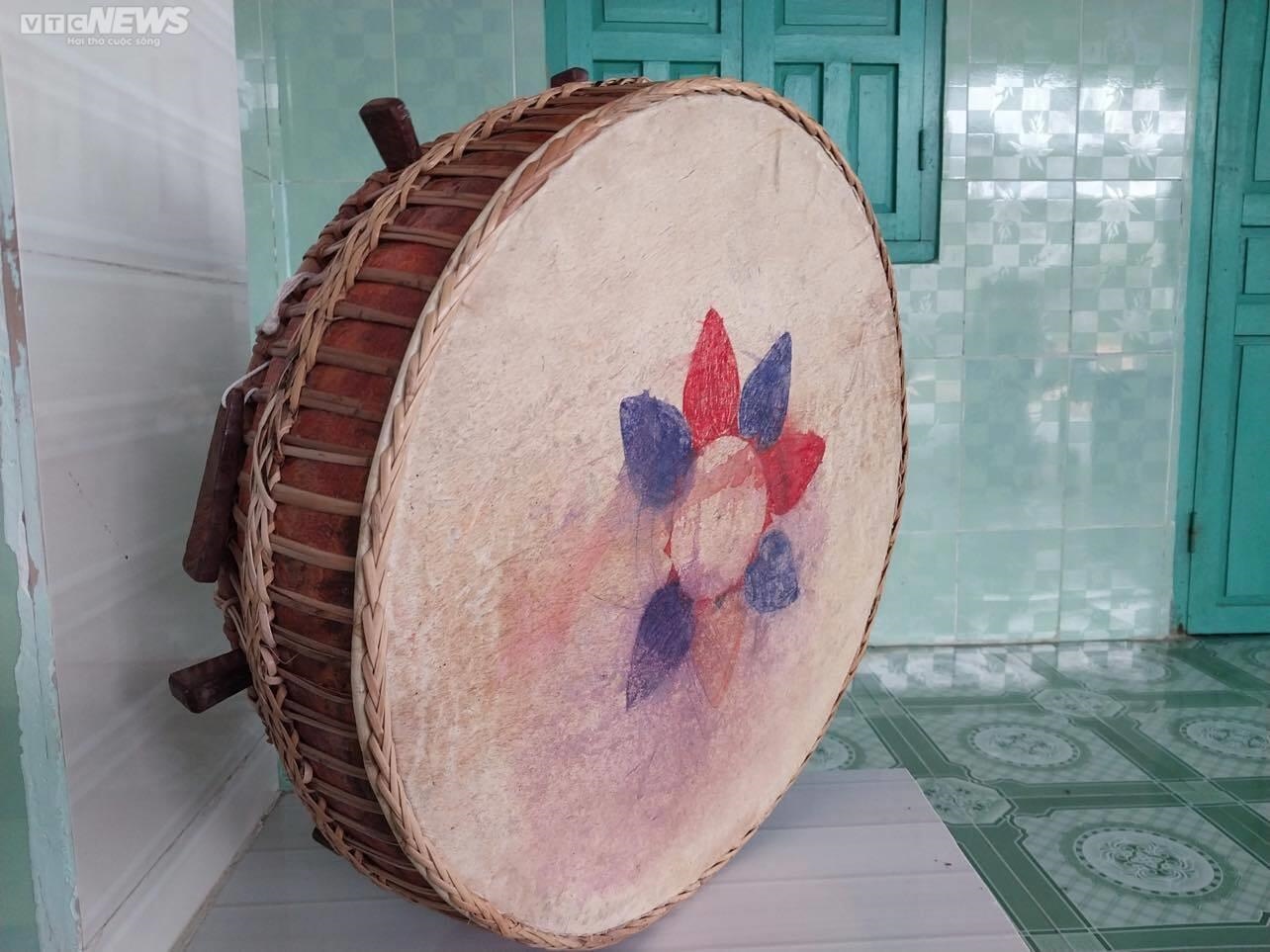
The drumhead is covered with young buffalo hide or goat skin.
As the user pushes the wooden pegs deeper into the drum, the drumhead becomes taut, producing a louder, more resonant sound. Conversely, pushing them further in will result in a softer, warmer sound. Additionally, Paranung drums are often decorated with various painted patterns on their surface.
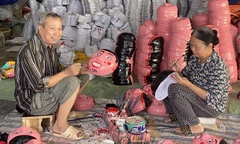
Respecting the value of traditional Cham musical instruments, artisan Han Quan dedicated a room of over 30 square meters as his "workshop." Here, he stocked it with equipment and materials for crafting musical instruments and items used in the religious activities of the Cham people, such as high trays, betel nut carriers, conch shell horns, and various types of drums.
Among them is the ceremonial umbrella used to carry the attire of the goddess Po Inu Nugar in Huu Duc village during the annual Katê festival, which he meticulously wove to express his gratitude to the goddess who taught the villagers farming, weaving, and livestock raising.
Mr. Quan said that over more than 50 years of crafting, his "workshop" has supplied hundreds of Paranung drum sets to the Cham people inside and outside the province, each priced from 4-5 million VND.
"The craft of making Cham drums is meticulous and elaborate, requiring skill, finesse, and a sense of responsibility from the craftsman. Before being "left the workshop," each drum must be adjusted to ensure the correct sound and long-lasting durability."Artisan Han Quan said."
For artisan Han Quan, his entire life has been dedicated to his passion for making and playing Paranung drums. As long as he lives, the drums will live on. As long as he has the strength, the sound of the Paranung drums will continue to resonate regularly.
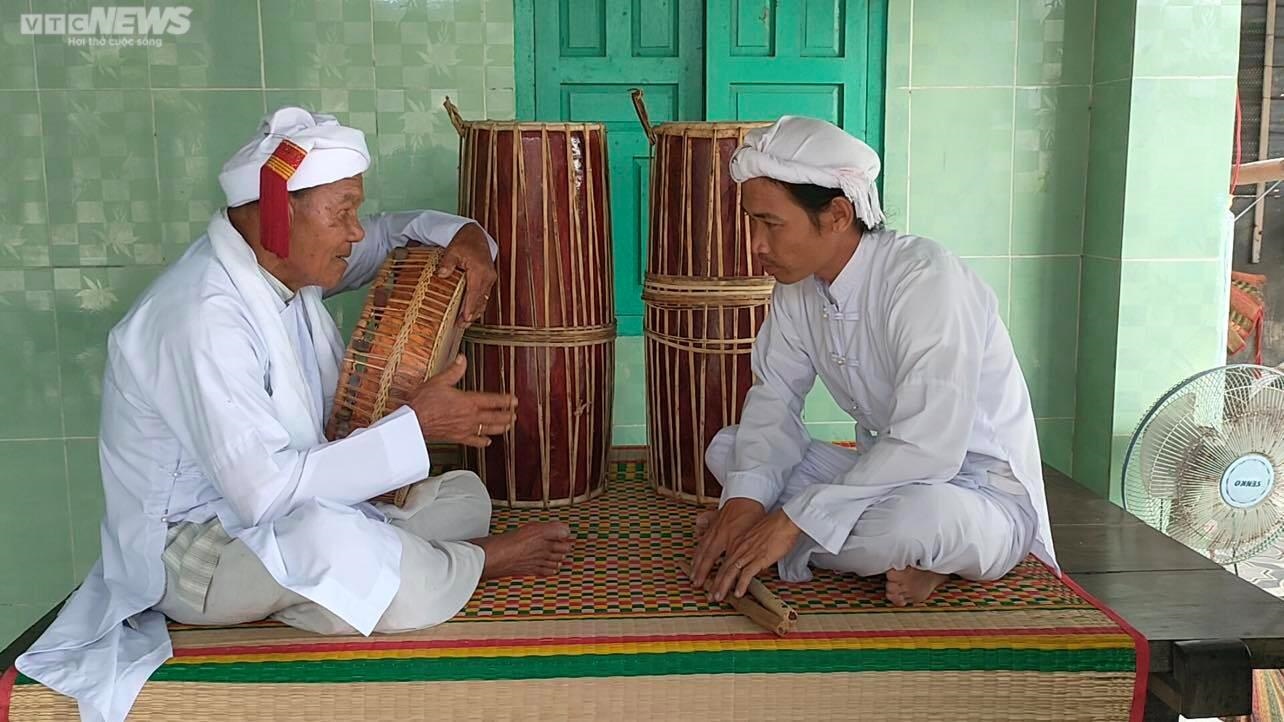
Mr. Han Quan taught his students how to play the drums.
Searching for the successor to make and play the Paranung drum.
It is no coincidence that Mr. Han Quan is called a "treasure" of the Cham people in Ninh Phuoc district in the field of crafting and performing traditional musical instruments, most notably the Paranung drum. Preserving that "spiritual life" is the result of a lifetime of hard work, dedication, and passion.
Stroking the Paranung drum, the elderly craftsman Han Quan suddenly sighed and said that drum makers must know how to handle an axe, plane, chisel, and carve wood, so it is very difficult to find successors. Furthermore, the Paranung is a simple instrument, but very difficult to use.
To master this type of drum, drummers must spend a long time studying under drum master Maduen. Nowadays, few young people are interested in making or playing drums anymore. Who knows how much longer the Paranung drum will survive when the number of successors is dwindling?
That worry haunted him even in his sleep. Therefore, artisan Han Quan voluntarily taught the techniques of crafting and performing musical instruments, especially the Paranung and Ghinang drums, to local youth.
What comforted the old craftsman was that during the years he painstakingly searched for someone to "keep the flame" of Paranung alive, although not many, there were still passionate young people who came to learn from him. Some of his students have become Maduen or musicians performing musical instruments for the Cham community.
According to Dang Phi Long Khanh, a student of artisan Han Quan, when teaching, artisan Quan wrote down the symbols for 72 Paranung drum pieces for him to play along with.
"Teacher Han Quan taught me very diligently. Every evening, he would call me to his house to teach and practice the Paranung drumming technique. I am very proud to be a student of the artisan Han Quan. He loved and wholeheartedly taught his students the proper drumming techniques.", Mr. Khanh shared.
As if to prove the effectiveness of his teaching, Master Han Quan and his students performed the Paranung and Ghinang drumming for us. With their smooth movements and skillful, graceful hands, the sounds of the Paranung and Ghinang drums resonated vibrantly, like a passionate dance, shimmering as if entering a mystical spiritual realm…
Musical instruments are an important element that creates the soul of Cham festivals. Cham musical instruments are an artistic means of attracting viewers to the festival, and conversely, Cham festivals are the place where Cham musical instruments are nurtured and preserved.
To preserve and promote traditional values, especially the traditional Cham musical instruments, Ninh Thuan province has supported localities with Cham populations in purchasing and teaching the use of musical instruments, sound equipment, and other tools. At the same time, it has encouraged the Cham people to establish more clubs to disseminate and pass on the skills of playing traditional Cham musical instruments.
 Comment