



 Hotline: 0855.911.911
  RSS
RSS 





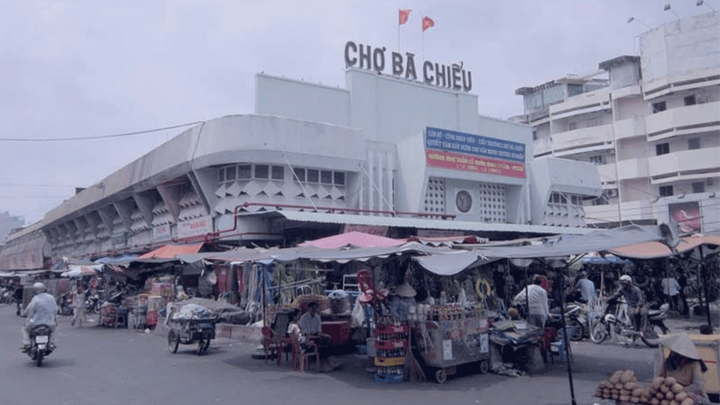
Ba Chieu Market is a large market located in the central area of Binh Thanh District, Ho Chi Minh City. It is one of the city's oldest markets, established in the 19th century. Initially known as Xom Market, it gradually developed and became the central market of Gia Dinh Province (a province established during the reign of Emperor Minh Mang, merged with Saigon in 1975, now corresponding to Thu Duc City and districts 7, 12, Binh Tan, Binh Thanh, Go Vap, Phu Nhuan, Tan Binh, Tan Phu, Binh Chanh, Can Gio, Hoc Mon, and Nha Be).
In 1942, the market was built by Mr. Tran Van Choi (nicknamed "Tu Choi") on a total area of 8.465 m². In 1987, the market was upgraded and renovated again.
Ba Chieu Market used to be a major wholesale market in old Saigon, specializing in supplying vegetables from Hoc Mon, Cu Chi, Da Lat, etc. Today, it is the central market of Binh Thanh District.
Ba Chieu Market used to be a major wholesale market in old Saigon, specializing in supplying vegetables from Hoc Mon, Cu Chi, Da Lat, etc. Today, it is the central market of Binh Thanh District. (Archival photo)
The name Ba Chieu Market has led many to wonder: Who was Ba Chieu?
Scholar Truong Vinh Ky (1837 – 1898), a renowned 19th-century writer, linguist, and cultural researcher, argued that Ba Chieu, like Ba Hat, Ba Diem, Ba Queo, and Ba Hom – famous markets familiar to the people of Saigon – were all named after the five wives of General Thang (Nguyen Ngoc Thang, a military general during the reign of Emperor Tu Duc, belonging to the first generation of anti-French resistance in Southern Vietnam; the Ong Lanh bridge across the Ben Nghe canal, connecting District 1 and District 4, is believed to have been built and named after him).
According to scholar Truong Vinh Ky, Commander Thang established five markets in different areas, assigning each of his wives to manage one. This solution had two purposes: firstly, to develop the economy, and secondly, to keep the wives busy with their businesses without conflicting with each other. The five markets were located in five different areas to avoid any contact between them. Accordingly, Ba Chieu was the name of one of Commander Thang's five wives.
However, writer Son Nam (1926 – 2008), a renowned researcher of Southern Vietnamese culture, offered a different explanation. According to him, Ba Chieu is the name of a region that appeared during the reign of Emperor Tu Duc (the latter half of the 19th century), and it is not the name of a specific person in history, but rather the name of a goddess.
According to Son Nam's explanation, Chieu means a natural pond; Ba Chieu is "a goddess worshipped beside a natural pond".
In the book From Ben Nghe to SaigonAccording to author Tran Nhat Vy, in the past, Ba Chieu market faced a small stream that branched off from the Nhieu Loc canal, meaning it had a natural water area.
Scholar Vương Hồng Sển (1902 – 1996), a cultural researcher considered to have a deep understanding of Southern Vietnam, also disagreed with the interpretation that "Bà Chiểu was one of the wives of Commander Thăng." In his book "Saigon of Yesteryear," he argued that caution should be exercised when considering Commander Thăng and Bà Chiểu, Bà Điểm, Bà Hom, Bà Hạt, and Bà Quẹo as husband and wife.
According to this scholar, Bà Hạt, Bà Điểm, and Bà Chiểu may have been the names of the first people to trade at these markets, and the markets were named after them by the locals. He cited the example of Bà Hoa Market in Tân Bình District, Ho Chi Minh City, which was built on land donated by a woman named Hoa, who was also the first person to trade there.
Thus, like many other ancient place names with folk origins, the exact and clear origin of the name Ba Chieu Market cannot be determined. Scholars only present their hypotheses for the public and researchers to consider.



 Comment