


 Hotline: 0855.911.911
  RSS
RSS 





During the tumultuous days of the August Revolution in 1945, on his way from the Viet Bac revolutionary base to Hanoi, President Ho Chi Minh instructed Minister of Interior Vo Nguyen Giap, the Ministry of Propaganda, and Comrade Xuan Thuy, one of the three leading cadres of the Provisional Revolutionary Committee of Northern Vietnam, to urgently establish a national radio station.
The directive from the Leader clearly stated two important aspects of the radio station: Domestically, it is the fastest and most widespread means of disseminating the policies and guidelines of the Party and Government, reflecting timely domestic and international situations; and it serves as a bridge between the Government and localities, and with the people.
Regarding foreign relations: This wave could cross national borders, without passports, to pierce the veil of imperialism's secrecy regarding the revolutionary situation in Vietnam, counter their propaganda and distortions, and gain the sympathy and support of the world's people for the Vietnamese revolutionary cause.
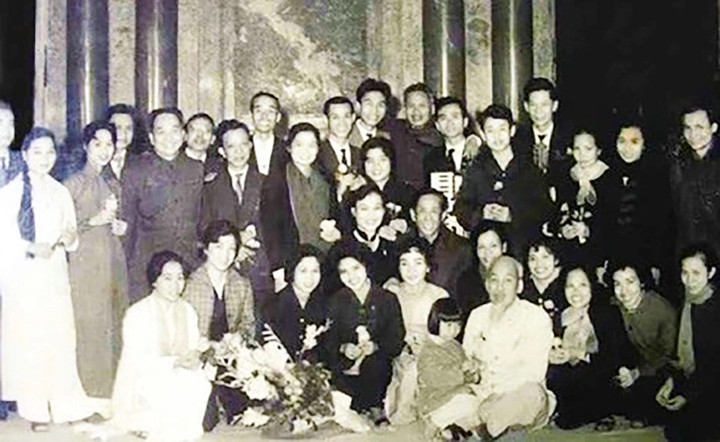
President Ho Chi Minh with officials, reporters, and artists of the Voice of Vietnam Radio in 1967 (Archival photo)
At 11:30 AM on September 7, 1945, the Voice of Vietnam Radio was established, marked by its first 90-minute broadcast, which included domestic and foreign affairs, music, and most importantly, the solemn broadcast of the full text of the Declaration of Independence read by President Ho Chi Minh at Ba Dinh Square on the afternoon of September 2, 1945.
"That moment in time, that historic hour, lasted only 90 minutes, but it will forever be etched in the memory of the Vietnamese people." (Pham Van Dong - Preface: Half a Century of the Voice of Vietnam - National Political Publishing House 1995).
The early days of the Voice of Vietnam (VOV) were also the months when the fate of the nation and the fate of the revolutionary government hung "by a thread." It was rare that, amidst the mountain of domestic and foreign affairs, and the daily and hourly struggle against "internal and external enemies," President Ho Chi Minh still devoted his precious time to VOV. He knew that the national radio station, born during the Revolution, had started from "nothing," from zero in terms of material resources, from a very young and inexperienced state in terms of political acumen.
He paid close attention to the content of propaganda broadcast on the radio. He deeply understood and was aware that the national radio station was a forum, a meeting place between the Leader and the People. Therefore, when there were difficult national issues or complex historical events, he would go to the radio station and speak directly to the people and soldiers.
During his lifetime, President Ho Chi Minh visited Vietnam Radio six times, each time assigning a new task or offering new advice. Editor-in-Chief Tran Lam recounted that each time President Ho Chi Minh visited the station without prior notice, accompanied only by a bodyguard, sometimes with a secretary, and without banners or slogans to welcome him.
President Ho Chi Minh's first visit to Vietnam Radio was at noon on March 9, 1946, after the Central Committee decided on a policy of "peace for progress," temporarily making peace with France, and signing the Preliminary Agreement on March 6, 1946. The political situation at that time was extremely complex, with reactionary parties distorting the truth and spreading rumors that "the Ho Chi Minh government was selling out the country."
Uncle Ho went straight to the radio studio at 4 Pham Ngu Lao Street, behind the Hanoi Opera House, and spoke directly over the airwaves to the people and soldiers nationwide, analyzing the Preliminary Agreement of March 6th and advising everyone not to listen to the enemy's distortions, but to unite broadly around the Government. Finally, Uncle Ho said emotionally: "Fellow countrymen, please believe that Ho Chi Minh was not a traitor."
The second time Uncle Ho visited Vietnam National Radio was at noon on October 23, 1946. After signing the Preliminary Agreement of September 14 with France, Uncle Ho arrived at Hang Co train station, spoke with the people of Hanoi, and then went straight to the station's studio at 4 Pham Ngu Lao Street to speak directly to the people over the airwaves of the National Radio Station.
He analyzed the French colonialists' plot to establish a "Southern Vietnam state," a divide-and-conquer scheme, as a springboard to invade the entire country. Finally, he choked up with emotion: “As long as our country remains ununified and our people continue to suffer, I cannot eat or sleep peacefully. I solemnly promise my compatriots that with their determination, with the determination of the entire people, our beloved South Vietnam will surely return to the embrace of our Fatherland.”The President instructed Editor-in-Chief Tran Lam to be extremely vigilant and guard against reactionary elements seizing microphones to spread counter-revolutionary propaganda. Never be complacent.
The third time President Ho Chi Minh visited Vietnam Radio was on the night of the 30th of Tet (January 21, 1947). After a government meeting in Quoc Oai, he went straight to Tram Pagoda, the station's first stop on its long resistance journey, "broadcasting while on the move," to wish the staff there a Happy New Year and to recite a poem wishing the people and soldiers nationwide, as well as overseas Vietnamese, a Happy New Year. He affirmed: "The protracted resistance will surely be victorious / Unification and independence will surely be achieved.".
Speaking to the staff of Vietnam Radio, Uncle Ho gave them instructions."The radio station is an extremely important tool of the Party and Government to guide and mobilize the people in the protracted resistance war and to break through the enemy's blockade aimed at isolating us. Therefore, you must ensure the continuous transmission of the Party and Government's voice in all situations."
The fourth time President Ho Chi Minh visited Vietnam Radio was in early 1955 at 58 Quan Su Street, Hanoi, one late afternoon. He arrived unexpectedly, going straight into the room of the Editor-in-Chief, Tran Lam. Seeing a little boy crying on the bed, President Ho Chi Minh comforted him skillfully, and the child immediately stopped crying. Mr. Tran Lam, who lived behind the house, ran in to greet President Ho Chi Minh. President Ho Chi Minh then asked: "Where is your mother? Why is she letting you cry like this?"The doctor told me to put up a mosquito net for the child to avoid mosquito bites.
Speaking with the staff of the National Radio Station, Uncle Ho praised them for having stabilized their living conditions and ensured continuous broadcasting under all circumstances since returning from the resistance war zone. Now that peace has come and conditions are better, they must work even better. Uncle Ho instructed: "Now that the resistance has succeeded, we have only gained independence and freedom for half the country. The revolutionary task is still long and arduous; you must maintain your revolutionary spirit and beware of sugar-coated bullets."
Regarding journalistic skills, Uncle Ho reminded us: "You must always remember that you are doing radio journalism, not print journalism. Whether it's radio or print journalism, you must always ask yourselves: Who are you writing for? What is the purpose of writing? What are you writing about? And how should you write it?"
When writing for broadcast journalism, one must pay attention to how they write and speak so that the listener understands exactly what they want to convey at a glance, making it easy for the listener to remember and follow. If you use overly complicated or difficult-to-understand language, the listener won't be able to stop to reflect and understand. Writing to be spoken aloud is different from writing for people to read on paper. It's crucial to avoid writing overly long articles, sentences that are too rambling, or overly wordy. To achieve this, you all must strive to improve your cultural level and enhance your skills in all aspects."
This was the fifth time President Ho Chi Minh visited the mobile broadcasting vehicle to see the workers. It was after the break of the opening session of the Third National Congress of the Party, on September 5, 1960, at the large lecture hall of the Nguyen Ai Quoc Central Party School (now the Ho Chi Minh National Political Academy). His arrival was unexpected, much to the surprise and overwhelming joy of the engineers and broadcasting technicians. He got into the vehicle, inquired about each person's health, and then smiled happily. "You guys get candy, but no cigarettes, because of that slogan over there."He pointed to the sign with the words "No Smoking" in red placed right in front of the recording booth. Before leaving the recording vehicle, he instructed: "To be a good broadcaster, you need to have high-level skills."
President Ho Chi Minh visited Vietnam Radio for the sixth time around 8 PM on New Year's Day 1961 at 39-41 Ba Trieu Street, while the station's staff, reporters, editors, broadcasters, and technicians were preparing a program to celebrate the Lunar New Year of the Ox. Editor-in-Chief Tran Lam invited President Ho to the studio on the second floor, but President Ho went down to the basement first to visit the police officers on duty. He inquired about the health of each officer and asked in detail about the methods used to ensure absolute security. He praised the national radio station's security measures as excellent.
Before entering the meeting room, President Ho Chi Minh asked Editor-in-Chief Tran Lam why the editorial office was located at Quan Su Street while the broadcasting station was at Ba Trieu Street. He argued that such a distance was inconvenient and even dangerous. What if the person delivering the news from the editorial office to the broadcasting station encountered difficulties? Journalist Tran Lam explained to President Ho Chi Minh that this was an unavoidable arrangement. The station had requested permission from the government to build a building next to the broadcasting station for the convenience of the editorial staff, but this had not yet been approved. The following year, the station received approval to build a three-story building at 45 Ba Trieu Street.
Speaking with the staff of Vietnam Radio and Television here, President Ho Chi Minh concluded: "Our country is still poor, so we must know how to promote initiative and overcome difficulties with a spirit of self-reliance and self-improvement. We must work like people from poor families, and not demand too much from the government. We must use and preserve the aid goods well so that they last a long time."
As on previous occasions, both during wartime and peacetime, President Ho Chi Minh visited Vietnam National Radio not only to inquire about people's well-being but also to conduct official business. He considered the national radio station the voice of the Party and the Government, a place for frank and timely exchanges with the people. On one occasion, Editor-in-Chief Tran Lam respectfully informed President Ho Chi Minh that peace had been restored, and that before visiting the station, they should let him know in advance so they could prepare a proper welcome. President Ho Chi Minh smiled warmly: "Uncle Ho is visiting the station to work, to speak with the people, and there's no need for elaborate ceremonies."
 Comment