



 Hotline: 0855.911.911
  RSS
RSS 





The riddle is as follows:
An old car needs to travel up and down a hill. On the first mile uphill, the car can only travel at an average speed of 15 miles per hour. On the first mile downhill, what speed must the car travel at to achieve an average speed of 30 miles per hour over the entire journey?
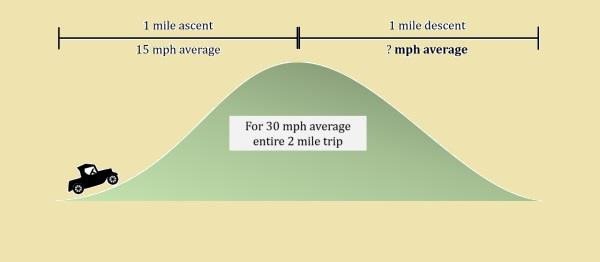
According to Mind Your Decisions, this is a fifth-grade math problem that psychiatrist Max Wertheimer sent to his friend Albert Einstein in 1934.
At that time, Wertheimer was a renowned scientist, one of the founders of the Gestalt school of psychology. Yet, the problem he sent to Einstein was incredibly simple.
It should also be noted that in that year, Albert Einstein became world-famous after winning the Nobel Prize in Physics in 1921. Since 1905, he had published four groundbreaking papers on challenging topics such as the photoelectric effect, Brownian motion, the theory of relativity, and the law of conservation of energy.
Therefore, that fifth-grade math problem seemed impossible to interest Einstein. Yet, the great scientist had to furrow his brow to find the answer. He even said that he didn't see the "trap" until he figured it out.
In your opinion, what is the correct answer to this simple problem that almost fooled even a genius physicist?
 Comment