


 Hotline: 0855.911.911
  RSS
RSS 





Term 2: Changing surname out of fear of tigers.
Most people in Thoi Binh district, Ca Mau province, still clearly remember the story of the Huynh family, where two members had their hearts ripped out by a tiger.
Ms. The, who sells coffee in front of the tiger shrine in Thoi Binh town, is only in her early 40s but still knows the story well. She said: "I heard it from my grandfather. Those two people were my great-grandfather and great-great-grandfather. They had their hearts ripped out by a tiger right at the beginning of Canal No. 1, near the tiger shrine behind this temple."
The person who knows this story best is probably Uncle Chín Bộ, in Hamlet 3, Thới Bình Commune, Thới Bình District. He is now 91 years old, but still very healthy and has a good memory, especially regarding past events.
Uncle Chín Bộ seemed delighted when I asked him about tigers. He said, "Every time Tet comes around, I feel closer to my ancestors. I always hope someone will come and listen to me tell stories of the old days, so that I can leave something behind for posterity about the traces of our forefathers."
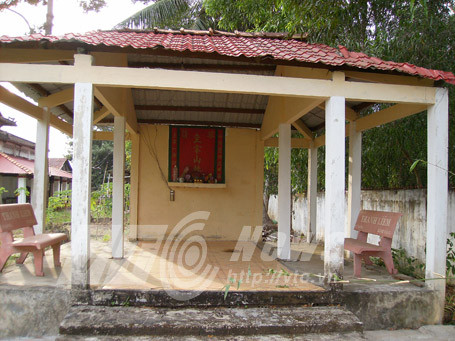 |
| The shrine dedicated to the tiger god in Thoi Binh today. |
Uncle Chín Bộ's real surname was Huỳnh, meaning Huỳnh Văn Bộ, but because of an incident where he was eaten by a tiger years ago, his father changed the entire surname from Huỳnh to Phan, and Uncle Chín Bộ thus acquired the name Phan Văn Bộ.
Uncle Chín was born and raised in Thới Bình, and because he had a keen interest in history, he was very knowledgeable about the formation and development of Thới Bình.
“Back when I was born and raised, this area was called Thoi Binh village. This village used to be famous for the story of the three-legged tiger,” Uncle Chin recounted with a chuckle.
Legend has it that, in the late 19th century, in the Miệt Thứ region – part of the U Minh Hạ melaleuca forest bordering U Minh Thượng, now Thới Bình district (Cà Mau province) and An Minh district (Kiên Giang province) – a three-legged tiger appeared.
It is rumored that this tiger got caught in a wild boar trap set by hunters, and to escape, it bit off one of its legs.
Uncle Chin said that tiger was very bold, daring to sneak into the village to stalk its prey. He recounted: "My father was about 7 or 8 years old at the time, and my grandparents often left him at home to plant rice. The tiger waited until my grandparents went to work in the fields, then sneaked into the house to try and catch my father. But it couldn't get inside because the house had a tiger-proof fence."
"It stuck its tail in to lure my father to grab it and pull him out. But thanks to the fence, my father wasn't caught."
After hearing her son tell her about a "very big cat," Uncle Chín's grandmother abandoned her farming work to stay home and look after him. And she saw that three-legged tiger.
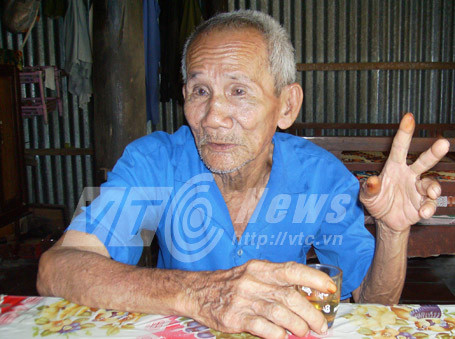 |
| Uncle Chín Bộ recounts stories about tigers and the incident where the Huỳnh family was attacked by tigers. |
One evening, the entire village of Thoi Binh was in a state of commotion as darkness fell and Mr. Huynh Van Sy still hadn't returned. Mr. Sy was someone the villagers had long regarded as a source of spiritual support in their lives alongside the three-legged tiger.
Mr. Sy was very skilled in martial arts and had faced three-legged tigers many times, yet he always remained strong. In the village, whenever there was a need to go deep into the forest, the villagers would invite Mr. Sy along, with the intention of scaring away the tigers.
As darkness fell and Mr. Sy remained missing, the villagers could no longer sit idly by. The men in the village gathered together, lit torches, and set out to search for him.
When everyone reached the beginning of Canal No. 1, they were horrified. It was a sight that even Uncle Chín Bộ cringed at when recounting it. He said: “On that muddy patch of land, the body of my great-grandfather Sỹ lay covered in blood. And the tiger was devouring my great-grandfather Sỹ’s heart right next to him!”
When he was alive, my father used to tell this story to warn us to be careful and avoid tigers."
Reviewing the scene of the battle between Mr. Sy and the three-legged tiger, the elders and experienced villagers of Thoi Binh confirmed that Mr. Sy was attacked by surprise, which led to his defeat.
“My father said that day, my great-grandfather Sy was returning from the forest, both hungry and thirsty. When he crossed to the other side of the Tram Trem River, which is now the Trem Trem River, he thought there were no tigers left. My great-grandfather broke off some forest leaves, rolled them into a makeshift horn to suck up fresh water from a coconut frond. While he was crouching down to drink, a tiger attacked him, and he didn't have time to react,” Uncle Chin added.
Nearly a year later, one of Huynh Van Sy's sons was attacked and eaten by the same tiger.
From then on, the villagers of Thoi Binh spread rumors that a three-legged tiger was deliberately hunting down the Huynh family, so the Huynh family in Thoi Binh village had to replace their surname with Phan at that time.
Why change their surname? And why Phan? Uncle Chin explained: "Back then, people strongly believed that tigers were spirited, that once they started eating a load, they would stick with it until they finished. The reason for changing their surname to Phan was because, while he was alive, my great-grandfather Sy often talked about his most respected friend, Phan Thanh Giản, a court official during the reign of Emperor Tự Đức."
After those two incidents, the villagers erected a shrine to the tiger, offering pigs as tribute annually to pray for peace.
"It is said that after the shrine was built and offerings were made annually, the three-legged tiger stopped killing anyone in the village."
Later, when I was growing up, I heard rumors that the tiger had returned to Thất Sơn. But honestly, I only heard stories; by my time, there were no more tigers in this area.
"Back then, I only heard that there was still one tiger left in the villages of Tan An, Nam Can district and Ngoc Hien district today," Uncle Chin said slowly.
Tran Vu
 Comment