


 Hotline: 0855.911.911
  RSS
RSS 





The U.S. military began using MREs (Meals, Ready-to-Eat) in the early 1980s, replacing the field-packaged combat rations (MCI or Meal, Combat, Individual) used from World War II until almost the entire Vietnam War. In September 2018, the menu for U.S. soldiers was enriched with a specially prepared pizza that could be used for three years, in addition to the 24 pre-packaged MREs. This was seen as one of the efforts to boost soldier morale (and avoid what is known as "military ration fatigue"). Let's take a look back at the history of military rations from the founding of the nation to the present day.
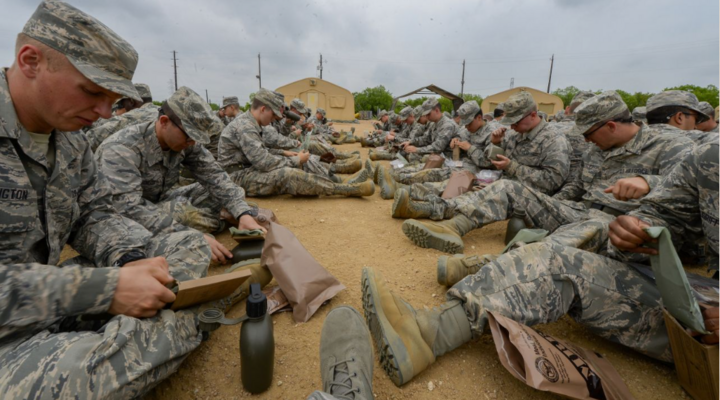
New recruits in the U.S. Air Force are being instructed on the use of MRE (Meal Emergency Response) ration kits.
Continental Army in the American Revolution
The American Revolution took place from 1765 to 1783 in the 13 colonies of the British Empire in North America. Commander George Washington led the Continental Army against the British to gain independence for the United States. However, he faced problems with military supplies.
The U.S. Congress lacked the authority to levy taxes and therefore lacked the funds to purchase food for the military, compounded by a host of other complexities, such as transportation and supply issues. According to Joseph Glatthaar, a history professor at the University of North Carolina-Chapel Hill, the consequence was that Continental soldiers often marched for days without food. “You would get some flour and maybe some meat, but usually the meat was pretty bad,” Glatthaar said.
In 1775, the U.S. Congress established a unified ration consisting of 450g of beef (or 336g of pork or 450g of salted fish), and 450g of flour or bread daily; 1,35kg of beans weekly, one liter of milk daily, one liter of rice weekly, and a quarter pint of spruce beer or cider daily.
Despite this, the military rarely provided enough food, so soldiers would request additional rations from civilians and supplement their meals with any animals they could hunt. The U.S. Congress pressured Washington to conquer and seize food supplies, but General Washington worried that doing so would alienate the colonies.
American Civil War
The American Civil War (April 1861 – May 1865) was a civil war that took place in the United States between the Union (North) and the Confederate States (South).
The Union Army had a standard ration: over 3 grams of meat, half a pound of wheat or corn flour, some vegetables, vinegar, and molasses. Professor Glatthaar said, “If you get the standard ration, it’s quite substantial. However, in reality, things gradually got worse: they started feeding the soldiers hard biscuits, salted meat, and dried vegetables.” The biscuits were made with flour and water, then dried to preserve them longer.
During campaigns, especially as Union troops moved south, they were able to plunder seasonal fruits and vegetables, such as apples and sweet potatoes, from orchards and farms along the way. In addition, these soldiers received supplies from home, as the Union postal system proved fairly reliable throughout the war. Both Union and Confederate troops used lake and stream water for drinking.
Chiến tranh thế giới thứ hai
During World War II, the U.S. military had two main types of rations: the C ration (for combat troops) and the K ration (less bulky and originally developed for airborne regiments). (An article on the website) History Professor Glatthaar, a history professor, said: “A Type C meal has six boxes, and the contents aren’t fixed. You’ll get a main course—like sausage and beans—some cigarettes, some canned fruit, some chewing gum, chocolate, some instant coffee, some toilet paper. There’s some cheese and biscuits. And a box of matches.”
Meal K consists of three “meals”: breakfast, lunch, and dinner, each containing over 100 grams of meat and/or eggs, cheese, biscuits, candy, chewing gum, salt cubes, and sugary drinks. It also includes cigarettes, wooden spoons, and toilet paper.
Vietnam War
From 1958 to 1981, American soldiers' rations were called individual combat meals (MCI), which were later replaced by mass-produced ready-to-eat rations (MRE). In Vietnam, these were issued to combat troops by the U.S. military in a cardboard box containing 1.200 calories with canned meat (possibly ham and lima beans, or bread with turkey), a box of “bread,” possibly crackers, and a box of dessert, such as applesauce, sliced peaches, or cake.
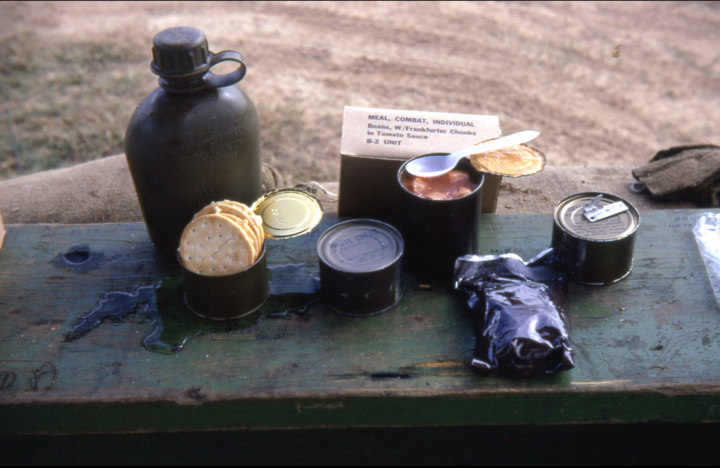
MCI rations for US soldiers during the Vietnam War, 1966-1967
A full ration seemed cumbersome, so soldiers often disassembled it, taking only what they needed during patrols and packing it into their backpacks. (In the book) Vietnam: An Epic Tragedy 1945-1975In his book, author Max Hastings writes that American soldiers cooked their rations by punching holes in the ration containers and using C4 explosives to heat them. Hastings also writes about the pills that American soldiers took daily, including antimalarial pills, salt lozenges, and Lomotil tablets, taken four times a day to control diarrhea.
MRE - Modern Dietary Reference Intake
This is a compact field ration designed for use by U.S. Army soldiers in current combat or field conditions. Military MREs are sometimes also distributed to civilians in the event of natural disasters or emergencies.
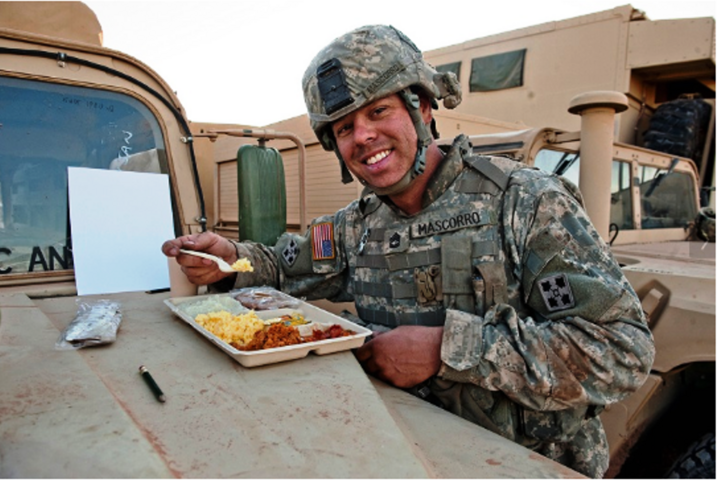
A U.S. Army soldier is eating lunch with an MRE (Meal Expected Recipient) ration.
According to the Soldiers ProjectEach MRE (Medium-Recycled Energy Drink) package from the US military provides approximately 1.200 calories and can last for up to 21 days (after the packaging is opened). According to some calculations, a male body needs about 2.500 calories per day, so just two MRE packages are enough for a soldier for one day.
The minimum shelf life of each MRE package is three years, although this may vary depending on storage conditions.
MRE packets are made from materials that can withstand parachute drops from a height of 400m, with each packet weighing 510–740g depending on its contents.
A typical MRE package usually contains a main course, a side dish, a dessert, or a snack-like treat. Common snacks in MREs for U.S. soldiers include crackers or bread, jelly, peanut butter or cheese mix, and powdered drinks (cocoa, instant coffee, or tea...).
Additionally, there's a spoon, a flameless food warmer, and a beverage mixing pouch.
The MRE bag also contained a few other items, including chewing gum, spices (salt, sugar, pepper, etc.), coffee powder, toilet paper, and a roll of matches.
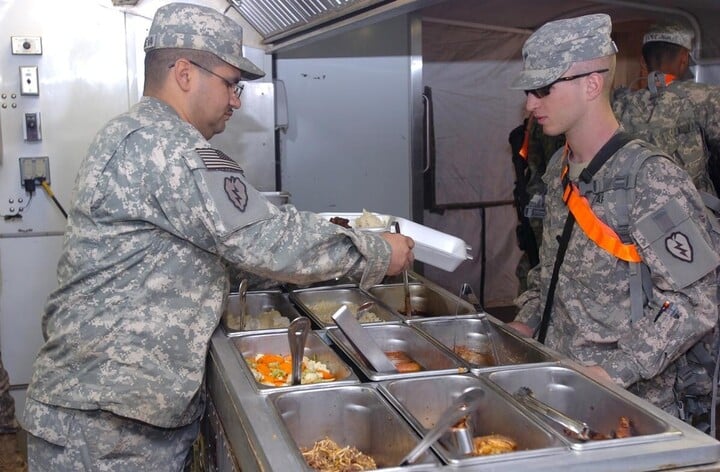
Under normal circumstances, American soldiers would have their own mess hall and chef.
American soldiers only eat MREs when marching or on missions in field conditions. In these cases, MREs are their only food source. Under normal circumstances, they would have their own mess hall and chefs.
>>>Little-known facts about provisions in the ancient Chinese army
>>>Ancient Chinese Army: Lavish feasts of meat and wine to reward soldiers before battle
What did Genghis Khan's or Napoleon's soldiers eat when they went into battle?

 Comment