


 Hotline: 0855.911.911
  RSS
RSS 





According to Buddhist legends and scriptures, Maitreya is a bodhisattva who will appear on Earth, attain complete enlightenment, become a Buddha, and teach sentient beings.
Who is Maitreya Buddha?
The story of Maitreya Buddha is found in the scriptures of most Buddhist schools (Theravada Buddhism, Mahayana Buddhism, Vajrayana Buddhism) and is accepted by most Buddhists as an event that will occur when the Dharma is forgotten on Earth. At that time, Maitreya Buddha will appear, attain enlightenment, and teach the Dharma to sentient beings, as Shakyamuni Buddha and many other Buddhas have done in the past.
Maitreya Buddha is considered the last Buddha who will appear on Earth in about 30.000 years according to the calendar of the Tushita heaven, which is about 5.76 billion years according to Earth years, when Buddhist teachings will have been completely forgotten on Earth. He is the Buddha of the future.
In Tibetan Buddhism, Maitreya Buddha is widely worshipped. In the modern world, images of Maitreya Buddha are ubiquitous, found not only in temples but also in shops, hotels, and private homes. In paintings and sculptures, Maitreya Buddha is often depicted seated on a throne, with his legs crossed or placed on the floor, signifying his readiness to rise and teach sentient beings.
Who is Maitreya Buddha?
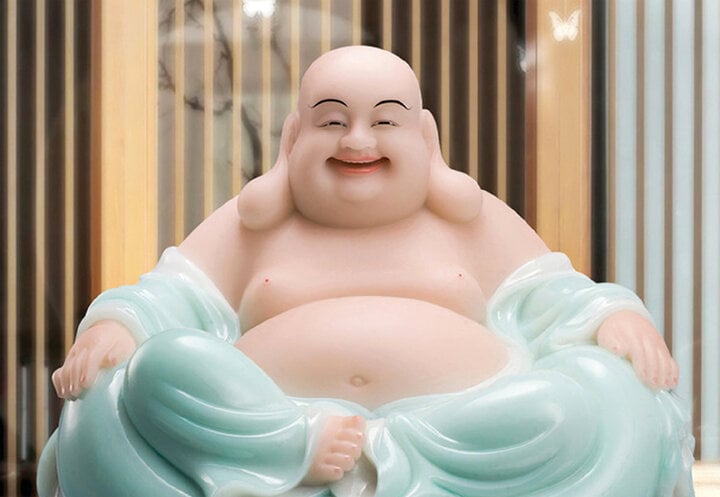
In China, Maitreya Buddha is often depicted as plump, gentle, and carefree, with a smiling face, a protruding belly, and children surrounding him. It is believed that this is the image of the monk Budai (meaning "cloth bag monk"), a Zen master who lived in the 10th century.
Legend has it that this monk was plump, with a narrow forehead and a large belly. He spoke erratically, slept wherever he pleased, and often carried a cloth bag with a staff to hold offerings from the people. He also possessed the ability to predict the weather, predicting sunshine and rain.
When did Maitreya Buddha appear?
According to Buddhist scriptures, when the lives of sentient beings in the world deteriorate due to moral decay, only engaging in evil deeds and neglecting good ones, lifespans will gradually decrease, lives will be filled with suffering, and epidemics will spread. At that time, Maitreya Buddha will appear as a spiritual teacher, similar to Shakyamuni Buddha of thousands of years ago.
He will widely spread compassion, kindness, love, and the lesson of karma. This will help improve the world's prosperity and enable sentient beings to abandon the path of creating negative karma through anger, greed, and moral decay. When these things are improved, human lifespan will begin to increase.
According to Buddhist scriptures, Maitreya Buddha's father was a king. Maitreya would be born into the queen while she was standing in her garden. The infant Maitreya would emerge, taking seven steps in four directions, and lotus flowers would bloom following his footsteps. Then he would declare: "I am the ultimate savior, rescuing all beings from suffering; this is my final reincarnation."
Hearing this, all beings rejoiced and offered sacrifices and gifts to him. The king, his father, also felt proud and paraded him around the city to delight the people. Beautiful celestial maidens would offer him flowers as offerings. Sages predicted that in this very lifetime, he would become a fully enlightened Buddha.
The symbolic meaning of Maitreya Buddha
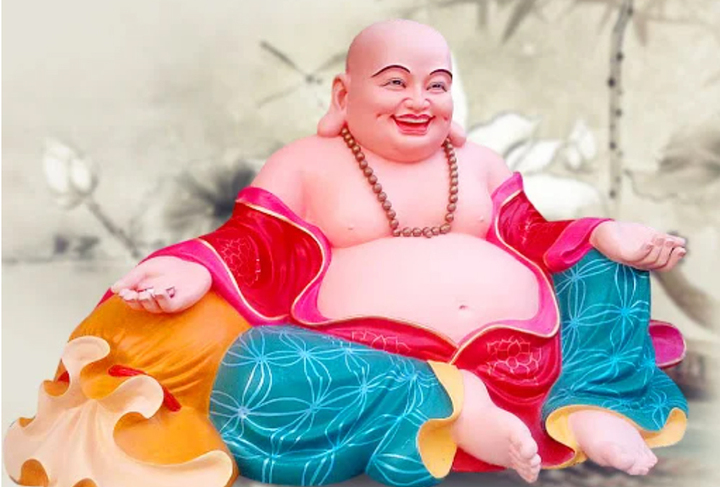
The smile of Maitreya Buddha evokes a feeling of boundless compassion, serenity, and tranquility.
In Buddhism, the smile of Siddhartha Gautama is called the smile of peace, while the smile of Maitreya Buddha is called the smile of joy. The image of Maitreya Buddha today is depicted with a plump figure, wearing a robe that reveals his round belly and navel, barefoot, with an open, benevolent face and a very bright smile.
The personality of Maitreya Buddha is also described as equally strange as his physical appearance; he speaks erratically and sleeps wherever he pleases.
The most striking feature when looking at the statue of Maitreya Buddha is his eternal, joyful smile, a symbol of boundless compassion and generosity. The Buddha's smile gives the viewer a feeling of immeasurable kindness, serenity, and peace.
His long ears symbolize compassion, the ability to listen to praise, criticism, and ridicule; he smiles even when mocked without taking offense. His round belly represents a vast and compassionate heart that can encompass all the joys and sorrows of the world.

 Comment