


 Hotline: 0855.911.911
  RSS
RSS 





The nationwide general uprising (August 1945) yielded tremendous results: the entire government fell into the hands of the Vietnamese people. On August 28, 1945, when the last remaining localities on the mainland and islands successfully launched their general uprisings, the Vietnam National Liberation Committee (elected by the Tan Trao National Congress) convened in Hanoi to reorganize into the Provisional Revolutionary Government and discuss preparations for its presentation to the nation.
On the afternoon of September 2, 1945, at Ba Dinh Square in Hanoi, before hundreds of thousands of people attending the rally... tinTo celebrate independence, President Ho Chi Minh, on behalf of the Provisional Government of the Democratic Republic of Vietnam, solemnly read the document. Declaration of Independence, giving birth to a new Vietnam.
The Declaration of Independence begins with a universal truth: “All men are created equal. They are endowed by their Creator with certain unalienable rights, among which are the right to life, liberty, and the pursuit of happiness.”
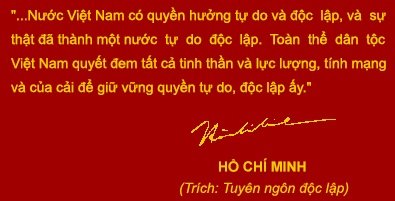
The oath of independence on September 2, 1945.
The Declaration of Independence affirms, "The truth is that our people reclaimed Vietnam from the Japanese, not from the French. The French fled, the Japanese surrendered, and Emperor Bao Dai abdicated. Our people overthrew the shackles of colonialism that had lasted for nearly 100 years to build an independent Vietnam. Our people also overthrew the monarchy that had lasted for many centuries to establish a democratic republic."
The Declaration of Independence solemnly proclaimed: "The Vietnamese nation has the right to enjoy freedom and independence, and has truly become a free and independent nation."
The Declaration concludes with the oath: "The entire Vietnamese nation is determined to dedicate all its spirit and strength, its life and property, to safeguarding that freedom and independence."
"Independence or death!"
At that time in Saigon, a sea of people flocked to Republic Avenue (now Le Duan Street) to listen to President Ho Chi Minh's message transmitted from Hanoi. There, Tran Van Giau, Secretary of the Regional Party Committee and Chairman of the Provisional Administrative Committee of Southern Vietnam, addressed the people and reminded them: "Rejoice in the victory, but do not be complacent," because the enemy was "plotting a conspiracy to relinquish the yoke of slavery on 25 million people," therefore, it was necessary to uphold the will to "resolutely resist all aggression," and "be ready to fight."
The Independence Day rally In Saigon, it immediately turned into a show of force with banners strung across the streets, written in English, Russian, French, and Vietnamese: "Independence or Death."
More than 20 days later, on the night of September 22nd to 23rd, 1945, anti-invasion gunfire erupted again in many places throughout Saigon.
At the Cay Mai Conference (house number 629 Cay Mai Street, now Nguyen Trai Street, District 5) in the early morning of September 23, 1945, a call to arms from the Southern Resistance Committee, drafted by Mr. Tran Van Giau the night before, was adopted, demonstrating the commitment to independence through action: “The French have begun to invade our country once again. On September 2nd, our compatriots swore to sacrifice their last drop of blood to protect the independence of the Fatherland: ‘Independence or death!’... The Resistance Committee calls upon: All compatriots, old and young, men and women, take up arms and charge forward to drive out the invaders.”
"We will fight to the death for our country!"
The dawn of the Vietnamese democratic republic was fraught with difficulties and challenges, requiring the resolution of the threat of war and the seizing of every moment of peace: the lingering consequences of colonial and feudal regimes, internal and external enemies threatening the fate of independence; the ruling party having to temporarily go underground; the government making one concession after another; President Ho Chi Minh personally communicating with the enemy, word by word, to salvage a precarious situation…
But the more concessions we make, the more the enemy advances: On the morning of December 18, 1946, the enemy demanded freedom of movement on the streets of Hanoi; on the afternoon of December 18, 1946, they demanded to take charge of maintaining order in the capital; on the morning of December 19, 1946, they demanded the disarmament of the self-defense forces… They are determined to seize our country once again.
The possibility of reconciliation had ended. President Ho Chi Minh presided over a meeting of the Central Party Standing Committee at Van Phuc (Ha Dong) on December 18, 1946, which decided to launch a nationwide resistance war.
On the night of December 19, 1946, the Lang Fortress fired three volleys at French positions in the city center, signaling the start of the nationwide resistance. The capital and the entire country resolutely upheld their oath of independence in the spirit of "Every citizen is a soldier, every house is a fortress, every street is a battle line," and "We will die so that the Fatherland may live!"
"National reunification is the path to survival for our people."
"Nine years of struggle culminated in Dien Bien Phu, creating a glorious chapter in history." The Geneva Accords, signed in 1954, recognized the independence, sovereignty, and territorial integrity of Vietnam. However, neo-colonialism soon emerged with the aim of permanently dividing Vietnam.
President Ho Chi Minh in Letter to the people of the whole country On July 6, 1956, it was clearly stated: "National reunification is the path to survival for our people." For more than 20 years (1954-1975), the Vietnamese people and army in both the North and South "resolutely dedicated all their spirit and strength, lives and property" to confront the new colonial war of aggression.
Video: Meet the people behind the historic photo 'Tanks entering the Independence Palace'
Our people had to endure 30 years of immense hardship and sacrifice to reach the joyous day of victory on April 30, 1975, and achieve "the most glorious victory, a shining symbol of the complete triumph of revolutionary heroism and human intellect," an event "of international importance and profound historical significance."
"For a noble purpose in life for all: Independence and freedom"
From the tumultuous days of the resistance war against the bombing campaign in North Vietnam, on July 17, 1966, in Hanoi, President Ho Chi Minh upheld the truth that "Nothing is more precious than independence and freedom" and spoke of "the day of victory, when our people will rebuild our country in a more dignified and beautiful way."
But when the country was finally reunified, still bearing many wounds, the sound of gunfire defending the borders and islands rang out again.
On the night of February 17, 1979, upon hearing the news that "gunfire had echoed across the border," composer Pham Tuyen composed a new marching song that concluded with President Ho Chi Minh's words: "For a noble cause for all: Independence and freedom." From the southwestern border to the northern border, from the mainland to the Truong Sa archipelago, the entire nation rose up to fight "to uphold freedom and independence."
Now, with the country's increased strength for consolidation and development, Vietnam not only has a name on the map but also holds a significant position and prestige on the international stage; it not only possesses unified sovereignty from the mainland to the distant islands but also maintains diplomatic and economic relations with over 180 countries across all continents. The Vietnamese nation has not only been reborn and brought honor to its ancestors of a thousand years ago but also possesses the stature and strength to integrate and discuss matters of the world, both now and in the future.
Many dangers and challenges remain, but the Oath of Independence from 1945 stands: "The entire Vietnamese nation is determined to dedicate all its spirit and strength, its life and property, to safeguarding that freedom and independence." We believe this to confidently move forward into the future!
 Comment