



 Hotline: 0855.911.911
  RSS
RSS 





The extinct volcano located northeast of Tay Ninh city, in Thanh Tan commune, 11km from the city center, is called Mount Ba Den. This mountain is 96km from Ho Chi Minh City and has an altitude of 986m. It is the highest mountain in Southern Vietnam, known as the "foremost mountain of the heavens".
According to the Gia Dinh City ChronicleThe mountain was originally named Bà Dinh. Many local elders believe its original name was Núi Một (Mountain One), and the name Bà Đênh only appeared around the mid-18th century, later gradually becoming Núi Bà Đen (Mountain Bà Đen). Some also call it Núi Điện Bà (Mountain Điện Bà). In short, the mountain's name is almost entirely related to a revered woman, and many people still refer to it simply as Núi Bà (Mountain Bà).
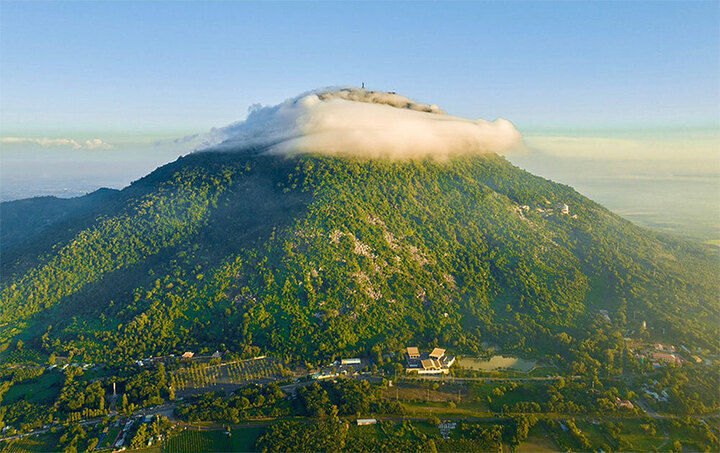
Ba Den Mountain in Tay Ninh. (Photo: Sunworld)
Who is Bà Đen?
This is not a historical figure. The character of Bà Đen exists in folk legends about a girl who died unjustly, then manifested as a spirit to save humanity and bring good fortune to people. The story of her as told by the people is connected to a historical era and involves several historical figures.
The story goes that Mrs. Den's real name was Ly Thien Huong, the daughter of a high-ranking official in Trang Bang during the Nguyen dynasty named Ly Thien. Her mother was Dang Ngoc Phung, originally from Binh Dinh, who came to Trang Bang to start a new life.
Ly Thien Huong was beautiful and from a well-educated family, so she attracted a lot of attention. In the village, there was a young man named Le Sy Triet, an orphan who had lost both his parents. He was fortunate to be raised by the monk Tri Tan, and was skilled in both literature and martial arts. He also harbored feelings for her.
One day, Thien Huong went to the mountain to worship Buddha and was surrounded by a gang of thugs. In her moment of danger, Le Sy Triet unexpectedly appeared and bravely rushed out to protect her. Moved by his chivalrous act, Thien Huong told her parents about it, and they agreed to marry her. However, before they could hold the wedding, Le Sy Triet had to join the army. Thien Huong promised to remain chaste and wait for him at home.
One day, while climbing the mountain to worship Buddha and visit her fiancé's foster father, she was surrounded by villains who intended to humiliate her. With nowhere else to run, Thien Huong threw herself into a ravine and committed suicide. After her death, she manifested as a dark-skinned woman, appearing in a dream to the mountain's abbot, instructing him to find Thien Huong's body and bring it back for burial.
Therefore, the monk called her Lady Black, and later generations called her Mrs. Black out of respect.
Once, while being pursued by the Tay Son army, Lord Nguyen Anh (later King Gia Long) took refuge in Ba Den Mountain. Due to a lack of food, his soldiers and generals were starving. Hearing of the sacredness of Ba Den Mountain, in his desperation, Lord Nguyen Anh prayed for her assistance. That night, Ba Den Mountain appeared in his dream, revealing a type of tree whose fruit could save the starving soldiers.
Upon waking, Nguyen Anh ordered his soldiers to pick the fruit to eat; he named it "Tung Quan fruit". In 1790, Nguyen Anh led his soldiers back to this mountain, built a shrine, bestowed the title Linh Son Dien, cast a statue, and conferred the title Linh Son Thanh Mau upon Ba Den.
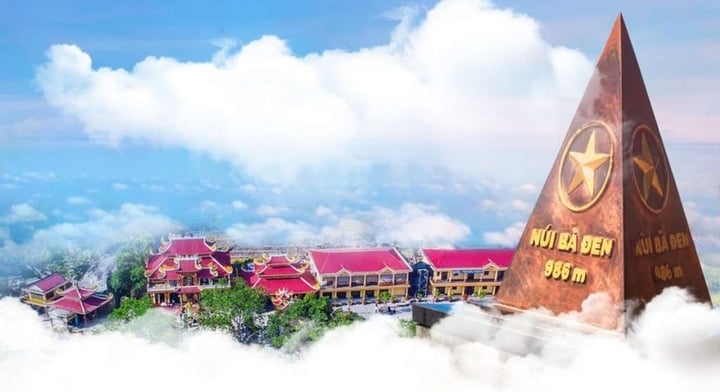
Ba Den Mountain tourist area in Tay Ninh. (Photo: Sungroup)
According to folklore, the story of Lady Den later reached the ears of Duke Le Van Duyet (a high-ranking official who served two emperors, Gia Long and Minh Mang). He resolved to investigate Lady Den and promised to submit a petition to the king requesting a royal decree for Ly Thien Huong if she manifested herself. One day, Thien Huong possessed a young girl to converse with him, saying: "The soul of the high-ranking official will later be transformed into a deity due to his talent and virtue; however, his physical body will be tormented and left incomplete."
Le Van Duyet said:"I'm not asking about my own future, but only want to know the root cause of her unjust suffering." With tears in her eyes, the girl recounted her unjust death, explaining that because she was still a virgin when she died, she became a celestial being and was sent down to earth to save humanity. After the goddess ascended to heaven, the girl was possessed and fell unconscious, only waking up much later.
Le Van Duyet asked the king to bestow the title of "Linh Son Holy Mother" upon Thien Huong - Ba Den Mountain, and from then on the mountain was known as Ba Den Mountain.
Several other explanations for the name of Ba Den Mountain.
Besides the story of Ly Thien Huong, folklore offers several other explanations for the origin of the name of Ba Den Mountain. Some believe that, in the past, the owner of this mountain area was a Funan woman named Re Deng, which later generations mispronounced as Den.
A legend is recorded in the book. "The Legend of the Holy Mother Buddha of Tay Ninh""It is said that, in the early days of reclaiming this land, an official who governed the foothills of Mount Mot (now Mount Ba Den) had two children, a son named Thach Bien and a daughter named Thach Nuong, commonly known as Denh."
When Denh was 13 years old, a Buddhist monk named Trung Van Danh, whose religious name was Truong Thanh, came to the middle of Mount Mot to build a temple. Because of her devotion, Denh asked to study Buddhism under the monk. Seeing her beauty, the governor of Trang Bang called a matchmaker to arrange a marriage for his son. While the two families were preparing for the wedding, she disappeared.
They searched everywhere and found a severed leg believed to be that of Lady Đênh. People speculated that Lady Đênh had been attacked by a tiger. Her family buried the leg and erected a tomb for her at the foot of the mountain, and the mountain was later named after Lady Đênh, gradually changing to Đen.
Currently, Ba Den Mountain is home to a national tourist area called "Sun World Ba Den Mountain," one of the destinations that always attracts many visitors. The Ba Den Mountain Spring Festival is held from the 4th day of the first lunar month until the end of the month every year, with the most important days being from the 4th to the 6th. During this time, pilgrims often ask for red paper packets containing handfuls of rice or small change, considering it a blessing from the Goddess at the beginning of the year.



 Comment