


 Hotline: 0855.911.911
  RSS
RSS 





This improves the prospects for a recovery in the Chinese economy as more people recover from infections.
Among those gathered to ski or ice skate on the frozen lake at Shichahai Lake Park in Beijing, some expressed optimism about China's reopening. The country lifted its strict "No COVID" anti-epidemic measures on December 7th to adopt a strategy of living with the pandemic.
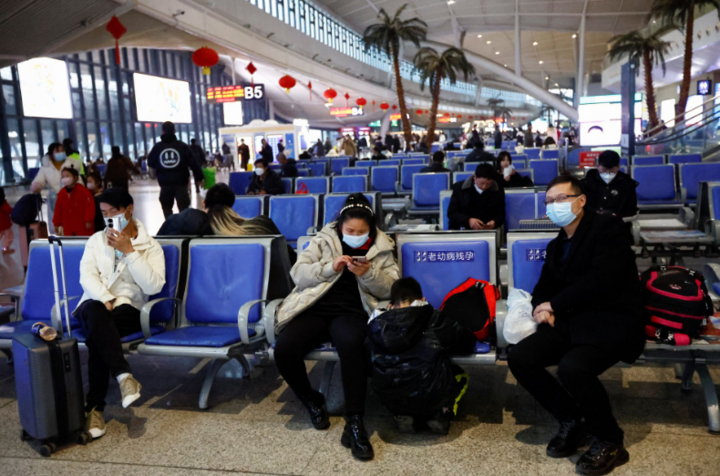
Chinese people are returning to normal activities after COVID-19. (Illustrative photo: Reuters)
"After this lockdown ends, we won't have to scan health codes anymore, nor will we have to check travel history.""A resident of the park named Yang shared.
Zhong, a 22-year-old university student, said he stayed home for two or three weeks after becoming infected.
"Now I can go out, and it's great that it's right in time for New Year's Day."", he said, "I want to take a tour around Beijing, see and experience the festive atmosphere."
Monday is a public holiday, but traffic in the Chinese capital has been bustling again in the past few days, as people flocked to outdoor venues for recreation. However, business remained relatively slow at some smaller, more limited-scale establishments, such as restaurants.
The owner of a seafood restaurant in Beijing said that customers have not yet returned in large numbers.
"I think this situation will continue through the Lunar New Year holiday." Chen said. "I think business will return to normal after the holidays."
In downtown Wuhan, where the pandemic began three years ago, people are no longer worried, a man surnamed Wu told Reuters.
"Production, work, life, and leisure activities are all returning to normal." Wu, a tutor at a private training center, added.
During the Lunar New Year holiday, 52,7 million domestic trips were made in China, a 0,44% increase year-on-year and a 42,8% increase compared to the same period in 2019, according to data released on January 2nd.
During this year's Lunar New Year holiday, China's railway network is expected to transport 5,5 million passengers, according to state television CCTV.
With expectations for tourism rising, authorities in Potala, Tibet, announced they will reopen to visitors on January 3rd. The tourist site closed last August due to the COVID-19 outbreak.
Some hotels in the southern tourist area of Sanya are fully booked for the Lunar New Year holiday, according to media reports.
Additionally, in recent days, Chinese state media has reported that the new COVID-19 outbreak has been brought under control and is nearing its peak.
The number of infections in the cities of Beijing, Guangzhou, Shanghai, and Chongqing is therefore nearing its end, according to Caixin news agency.
However, infections will peak in Sichuan, Shaanxi, Gansu, and Qinghai provinces in the latter half of January, the report added. Local disease control and prevention centers said more than 80% of people living in southwestern Sichuan have been infected.
According to official data, the death toll related to COVID-19 in China is 5.250. Several countries, such as Qatar, the US, and India, have implemented COVID-19 testing for travelers from China due to concerns about the scale of the new outbreak. European Union health officials are also holding talks on a coordinated response to the surge in COVID-19 cases in China. No decision has yet been made.
Market signals
Detailed information about China's manufacturing sector is likely to influence upcoming changes in this market.
According to the ReutersThe Caixin Purchasing Managers' Index (PMI) for China's manufacturing sector is expected to continue its decline for the fifth consecutive month, falling to 48,8 in December 2022. In November 2022, the index was 49,4.
The world's second-largest economy is undergoing a multitude of economic, political, and social upheavals, which will only intensify in the coming weeks and months due to changing COVID-19 policies.
This comes after official PMI data from China over the weekend showed the sharpest decline in December in nearly three years, as COVID-19 cases severely impacted production lines.
However, the impact on asset markets is less clear, as potential inflationary pressures from reopening the economy could force central banks to keep interest rates higher for longer periods.
Meanwhile, there is an unusually strong consensus among economists that the US economy will fall into recession this year.
Overall, investors were pleased to see 2022 come to an end. Global equities lost approximately $14 trillion and recorded the second-worst annual performance, while bonds had their worst year in decades.
Much of that stems from nearly 300 interest rate hikes around the world last year. Despite numerous policy tightening measures globally, the full effects are yet to become apparent.

 Comment