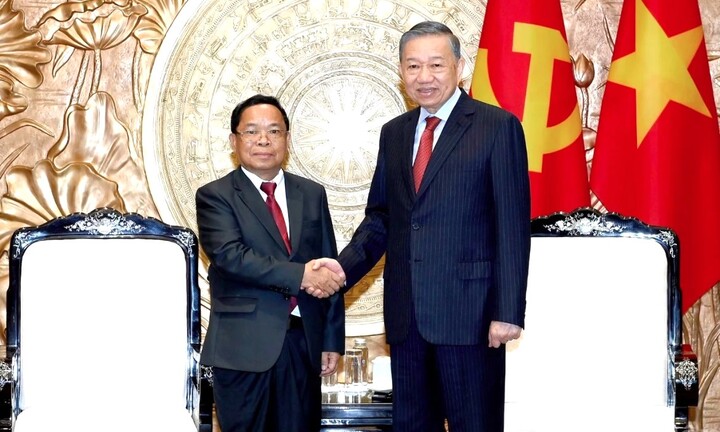
On June 16, General Secretary and President To Lam received Comrade Khamphan Phommathat, Member of the Political Bureau, Deputy Prime Minister and Minister of Justice of Laos, who was visiting and working in Vietnam.
After nearly a year of operation, the two-tiered local government model is assessed to have brought about many positive changes, but there are still obstacles that need to be overcome.
Regarding the handling of difficulties in using artificial intelligence in reviewing legal documents, the Deputy Prime Minister emphasized that AI is only a supporting tool, not a replacement for humans.
Prime Minister Le Minh Hung requested the Ministry of Justice to improve the effectiveness of civil and administrative enforcement, especially the recovery of assets obtained through corruption and economic crimes.
The Ministry of Public Security has proposed the establishment of a national center for combating fake news and misinformation to improve efficiency and optimally address this problem.
The Ministry of Interior has proposed increasing the nursing care allowance for groups of people who have rendered meritorious service and adding subsidies for those who serve veteran revolutionary cadres.
The National Assembly passed a resolution to pilot a two-year program allowing officials, civil servants, public employees, officers of the People's Army, and officers of the People's Public Security to work as public lawyers.
The Ministry of Justice held a ceremony to launch the National Database on Law (new version) and the Information System supporting the comprehensive review of legal documents.
According to the government's proposal, citizens have the right to request civil registration at any commune-level People's Committee, regardless of their place of residence or administrative boundaries.
The Ministry of Justice is coordinating with the Hanoi People's Committee and other ministries and agencies to develop the draft Law on the Capital City (amended) to ensure its timely submission to the 16th National Assembly at its first session.
In 2026, the Ministry of Justice will accelerate administrative reforms, focusing on institutional reforms; building a team of qualified officials, and developing e-government and digital government.
Minister Nguyen Hai Ninh affirmed that Resolution 66-NQ/TW is a "call to action" for profound institutional reform, creating breakthroughs in the development and improvement of laws.
The year 2025 marks many important developments in the judicial sector, with 15 key events clearly reflecting its central role in building and perfecting institutions.
The Prime Minister emphasized the need for innovative thinking in lawmaking, shifting from "governance by law" to "building institutions for development," and enhancing enforcement capacity.
According to Minister Nguyen Hai Ninh, 6.471 cases have been completed, recovering over 27.416 billion VND in funds misappropriated in criminal cases related to economic crimes and corruption.
The Deputy Director of the Civil Enforcement Department, Ministry of Justice, stated that Mr. Trinh Van Quyet, former Chairman of FLC Group, has fulfilled his civil enforcement obligations.
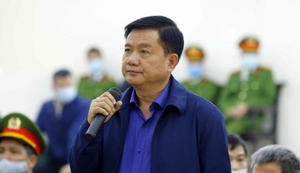
Mr. Dinh La Thang was ordered to pay over 830 billion VND in court fees; however, Mr. Thang and his wife only owned one asset, an apartment worth nearly 5 billion VND, which has already been subject to enforcement proceedings.
The Minister of Justice emphasized that the core value of digital transformation and technology must be built on the foundation of guaranteeing human rights and civil rights.
The "Not Alone" campaign aims to build a multi-faceted dialogue space, concretizing the spirit of the Hanoi Convention, and protecting children from the dangers of cybercrime.
The draft Law on Forensic Examination (amended) proposes that the Criminal Technical Department of the Provincial/City Police be authorized to conduct forensic examinations of injuries.
According to Minister Nguyen Hai Ninh, several unprecedented major cases will be brought to trial and have effective enforcement in 2025, such as the Van Thinh Phat and FLC cases.
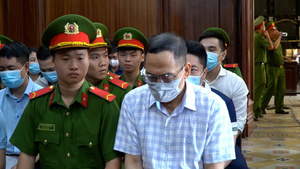
The Ho Chi Minh City People's Court sentenced defendant Hoang Quoc Hung (born in 1963, former Director of the National Center for Criminal Records) to 17 years in prison for the crime of accepting bribes.
Taking advantage of the victims' psychology, the perpetrators require the victims to transfer a sum of money in advance or participate in "tasks" to withdraw money held in the system.
The draft law amending and supplementing a number of articles of the Law on Handling Administrative Violations proposes increasing the maximum fine for traffic violations from 75 to 150 million VND.
The government proposes abolishing the authority of district-level People's Councils and People's Committees to issue legal normative documents and replacing it with the authority of commune-level People's Councils and People's Committees.
The Ministry of Public Security has proposed applying electronic monitoring as a penalty for individuals serving suspended sentences for offenses such as illegal street racing, mistreating grandparents, parents, spouses, children, and grandchildren.
The Ministry of Justice proposes that the People's Councils and People's Committees at the commune level issue resolutions and decisions to regulate matters assigned by laws and resolutions of the National Assembly.
The Ministry of Justice has proposed amending and supplementing several articles of the Vietnamese Nationality Law, including "loosening" policies regarding the acquisition/restoration of Vietnamese citizenship.





 Hotline: 0855.911.911
  RSS
RSS