The National Assembly officially passed the Law amending and supplementing a number of articles of the Planning Law, the Investment Law, the Law on Investment under the Public-Private Partnership Method, and the Bidding Law.
The Ho Chi Minh City People's Committee plans to use five prime plots of land, totaling over 3 hectares, to compensate businesses undertaking a Build-Transfer (BT) project for a 2,75km road section.
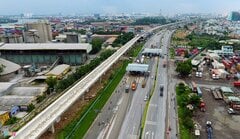
The BT project "Completing the Ring Road 2," connecting Thu Duc District directly with the central districts of Ho Chi Minh City, has been delayed by 4 years and the completion date remains unknown.
The State Audit Office has identified several shortcomings in the implementation of two BT (Build-Transfer) projects in Thu Thiem: the four main arterial roads and the Thu Thiem 2 bridge.
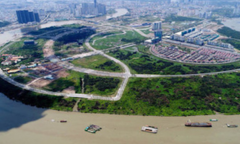
To expedite the implementation of numerous investment projects, the Ho Chi Minh City People's Committee has approved the continued deployment of many Build-Transfer (BT) projects in the Thu Thiem New Urban Area (District 2).
The Ngoc Hoi traffic junction project (with an investment of over 1.350 billion VND), which Khanh Hoa province assigned to Phuc Son Company under the BT (Build-Transfer) model, is currently "stalled" after two years of construction.
Before being allocated as reciprocal land to BT project investors, most of the land was agricultural land with very low value. However, after the BT project is implemented, the land value will increase many times over.
In 2018, auditing 5 BT projects and 8 BOT projects, the State Audit Office discovered and recommended the handling of financial irregularities totaling nearly 4.000 billion VND.
With the BT (Build-Transfer) projects halted, many localities believe that the Ministry of Planning and Investment needs to quickly find solutions to prevent businesses and localities from falling into difficult situations.
HoREA argues that the final settlement process for BT projects often takes a very long time, even years, and if the regulation stipulates that BT projects can only be paid after the project has been finalized, it would be very detrimental to investors.
HoREA has submitted comments on the draft Decree regulating the use of public assets to pay investors when implementing projects under the BT (Build-Transfer) model.
According to many experts, the Ministry of Finance's decision to temporarily suspend the use of land funds to pay investors implementing build-transfer (BT) projects is truly necessary.
Professor Dang Hung Vo (former Deputy Minister of Natural Resources and Environment) stated that the "land-for-infrastructure exchange" mechanism is considered an initiative of Ba Ria - Vung Tau province dating back to the 1990s.
A comprehensive and accurate understanding of the current land-for-infrastructure exchange issue is needed. It's crucial that the State assesses which BT (Build-Transfer) projects are good and which are not, avoiding the generalization of all projects and the fear of one or two mistakes leading to the halt of all of them.
The People's Committee of Bac Ninh province has just issued a decision to inspect two BT projects: the investment project for the construction of the Bac Ninh City Surface Water Treatment Plant and the investment project for the construction of Provincial Road 277, the section from Tu Son town to Cho town, Yen Phong district.
BT (build-transfer) projects have recently sparked public debate, particularly at the 5th session of the 14th National Assembly, where the State Audit Office confirmed numerous irregularities in BT investments.
Land allocation without auction, primarily based on price frameworks issued by the Provincial People's Committee, coupled with reduced coefficients and a "request-and-grant" mechanism, leads to losses for the State on both ends, while investors benefit on both sides.
The Hanoi Department of Planning and Investment (DPI) has just announced information about the project to build a road from Le Trong Tan Street to Ring Road 3 in Thanh Xuan District using the land-for-infrastructure exchange model.
In its latest financial report, Damsan Joint Stock Company (ADS) – the investor of the social housing project for low-income earners in Thai Binh City – is burdened with liabilities totaling over VND 1.143 billion (2,6 times its equity), amidst a surprising increase in inventory and revenue-related expenses.
Mr. Nguyen Thanh Phong instructed relevant departments and agencies to temporarily suspend BT projects currently under discussion and negotiation, pending the establishment of new procedures for their continuation.
Improper investor selection procedures, investors lacking sufficient financial capacity, and infrequent and lax inspection and supervision in BT contracts have led to a series of violations...
One of the irregularities in Hanoi's BT projects, as pointed out by the Government Inspectorate, is the lack of strict supervision, resulting in projects being behind schedule and prolonged implementation times, thus increasing investment costs.





 Hotline: 0855.911.911
  RSS
RSS