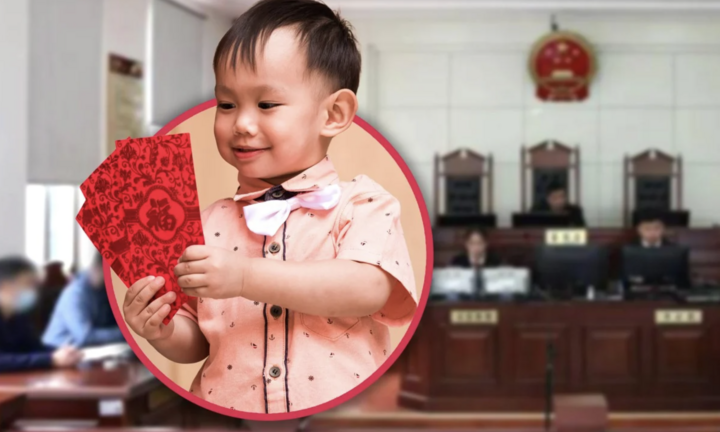
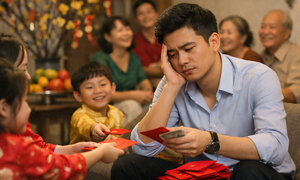
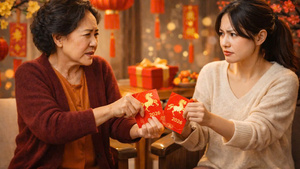
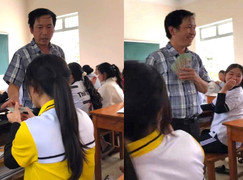
A father in China sparked controversy when he withdrew over 300 million Vietnamese dong (approximately $17.75) from his son's Lunar New Year gift money to pay for his new wife, and the court ordered him to repay the entire amount, including principal and interest.
I'm in 8th grade now, and I'm fed up with Mom asking how much money someone gave me every time I open a red envelope, just to judge them. I understand that better than Mom thinks.
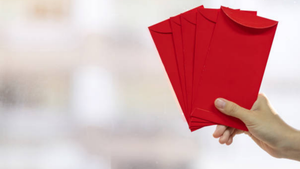
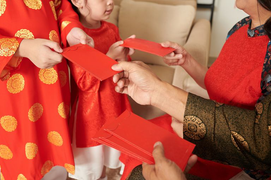
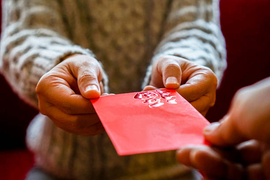
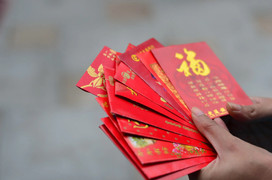
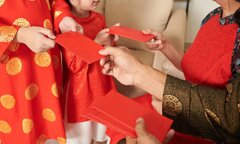
Traditionally, giving lucky money (lì xì) at the beginning of the year was meant as a wish for good fortune and health, conveyed in a red envelope by the giver. However, at some point, it became a matter of measuring and weighing the amount, whether it was a little or a lot.
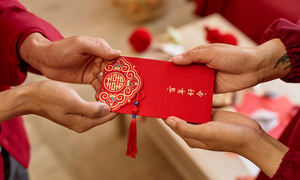
Originally, red envelopes were only given to convey good luck and New Year's wishes, but in many families, giving these envelopes is gradually becoming a measure of wealth, generosity, and even prestige.
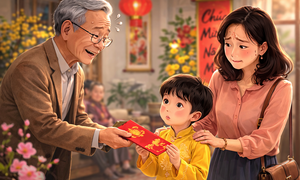
Amidst the bustling atmosphere of Tet greetings, a red envelope containing 20.000 dong, accompanied by the words "for good luck," and the mother's awkwardness, made me feel a pang of sadness.
Every time I return to my hometown from Ho Chi Minh City for Tet (Lunar New Year), I carry with me a very real worry: whether the red envelopes are thin or thick can become a measure of my worth.
By the end of the first day of the Lunar New Year, I had spent over 15 million VND on lucky money, receiving only 200,000 VND back; at 30 years old and still unmarried, I'm automatically considered "the rich kid," so I have to constantly reach for my wallet.
What started as a custom of wishing good health to the elderly and peace to children, giving lucky money has gradually transformed into a financial "race" and a psychological burden.
Some people go to wish others a Happy New Year with the sole concern in their minds: "Will I be considered stingy for giving such a small gift?"; others are exhausted from trying to "maintain appearances" so as not to be outdone.
At the age of 14, many children receive millions of dong in lucky money, but my son only received an envelope with 500 dong, just enough to fulfill one personal wish.
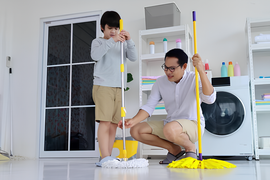
Many parents give their children regular allowances and Lunar New Year lucky money, so why not let them do household chores and reward them for their hard work?
Parents who illegally seize their children's Lunar New Year lucky money may be fined between 20 million and 30 million VND and ordered to return the seized property.
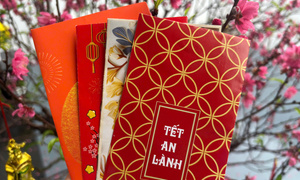
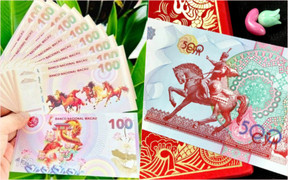
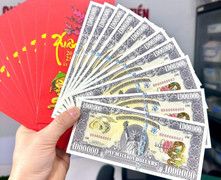
Banknotes featuring the horse mascot of 2026 are being offered for sale at prices ranging from tens of thousands to hundreds of thousands of Vietnamese dong.
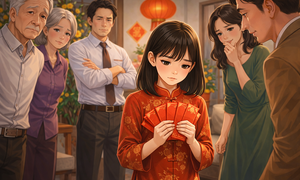
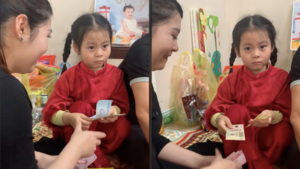
A video of a little girl dutifully returning her Lunar New Year lucky money to her mother, with a distraught and sad expression as if she's about to cry, is going viral on social media, and many adults are also feeling sympathetic.
For young people in Generation Z, 100 million VND is not a small amount of money, and without a specific plan, it could be completely gone in just a few months.
By taking back the Lunar New Year money when my grandchild angrily complained that it was too little, I refused to compromise with the behavior of parents who implicitly allow their children to view Tet as an opportunity to earn lucky money.
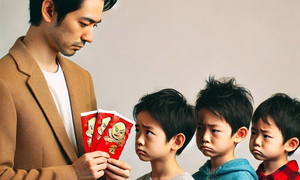
My first meeting with my girlfriend's family would have been perfect if it weren't for the mishap during the red envelope exchange. The children opened the envelopes and made faces, and her child pouted, "There's only 50 dong in it..."
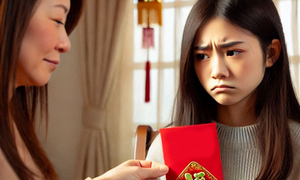
Instead of receiving the Lunar New Year money and immediately stuffing it into her mother's hand like every year, this year the 13-year-old girl resolutely refused to take it, explaining with dissatisfaction: "Mom will take it all back anyway."
Knowing the story of fairies transforming into coins wrapped in red paper to ward off evil spirits from bothering children on New Year's Eve, people also wrap money in envelopes to give to children.
Like any subject, learning about money management requires both theory and practice. Parents shouldn't keep all of their children's Lunar New Year money; instead, they should use it to teach children how to spend it wisely.
Every Lunar New Year, my son receives nearly 5 million VND as New Year's gifts, and I keep most of it; this year, since my son is 13, I decided to let him keep the entire amount to teach him how to manage money.
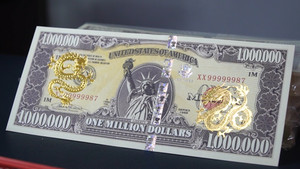
On social media, many posts are advertising the sale of unique and rare banknotes, including new ones with attractive serial numbers and gold-plated banknotes featuring the snake zodiac animal, to be given as gifts during the upcoming Lunar New Year 2025.
Chinese netizens are outraged after a father demanded that the court grant him half of his children's Lunar New Year gift money (worth 890 million VND) during a divorce trial.
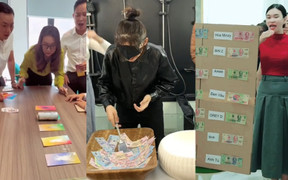
Many unique and humorous ways of giving lucky money to employees have been shared by netizens in the first few days back at work after the Lunar New Year of the Year of the Dragon.
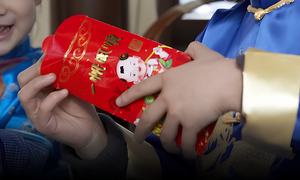
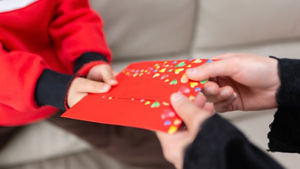
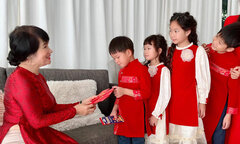
During Tet (Vietnamese New Year), children are excited to receive lucky money envelopes from adults, but parents wonder whether or not they should let their children keep the lucky money.
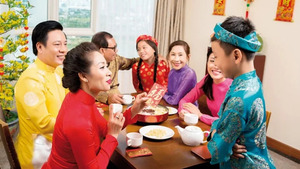
Tet is perhaps the time that children look forward to the most, not only because they get to gather with family and eat delicious food, but also because they receive lucky money envelopes.
Mr. Chinh Vuong (Hanoi) has collected and displayed commemorative banknotes and real currency from various countries featuring dragon images to serve the demand for Lunar New Year gift money in 2024.





 Hotline: 0855.911.911
  RSS
RSS