


 Hotline: 0855.911.911
  RSS
RSS 





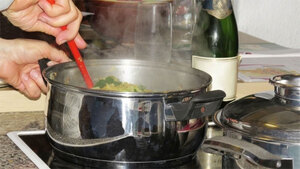
Non-stick pans are considered an invention that frees up labor and reduces the amount of oil and fat consumed. The most common non-stick coatings today are usually made from Polytetrafluoroethylene (PTFE, also known as Teflon) or ceramic. They have extremely strong water-repellent and oil-repellent properties, creating a perfectly smooth surface.
However, this chemical coating is extremely fragile and susceptible to physical and temperature deviations. In fact, the main cause is not the product quality but rather the following five common but incorrect usage habits.
Wash the pan with cold water immediately after use.
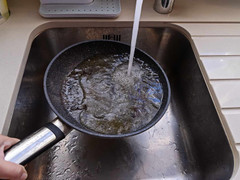
This is the most destructive and dangerous habit for non-stick pans. After frying or stir-frying, many home cooks instinctively rush the sizzling hot pan into the sink and rinse it with cold water, or listen for the satisfying "hissing" sound. This phenomenon is called thermal shock.
Non-stick pans are typically constructed from multiple layers of different materials, each with a different coefficient of thermal expansion. When cooled suddenly, the metal core contracts at an extremely rapid rate, while the non-stick coating cannot expand quickly enough. This difference breaks the mechanical bonds between the coating and the pan's base, leading to warping of the pan's bottom, blistering of the non-stick coating, and peeling off in small pieces.
Solution: Allow the pan to cool completely before washing. If you need to clean it immediately to cook another dish, wipe away excess grease with a paper towel or rinse with warm water.
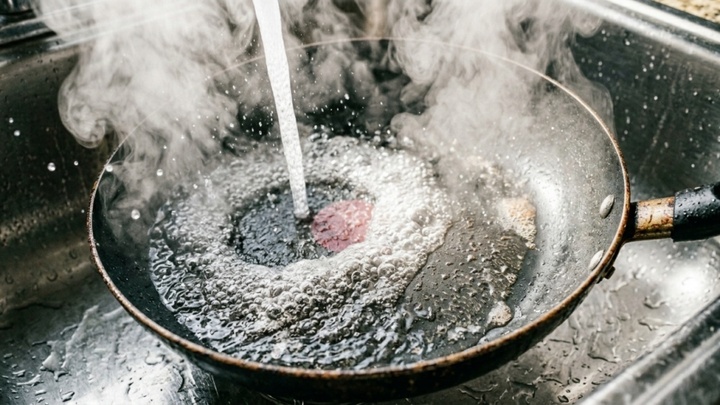
Thermal shock is the fastest way for non-stick pans to break down. (Photo: CT)
Heat an empty pan on the stove over high heat.
In the art of cooking with cast iron or stainless steel pans, chefs often wait until the pan is very hot and smoking before adding oil to create a natural non-stick effect. However, applying this principle to non-stick pans will only damage your equipment.
When an empty pan is placed over a high flame, because there is no food or liquid to absorb and dissipate heat, the surface temperature of the pan can skyrocket to 300°C in less than 2 minutes. At temperatures above 260°C, the PTFE coating begins to chemically degrade, losing its smooth texture.
More seriously, if the temperature reaches 350°C, the coating will release toxic gases, causing "polymer vapor fever" syndrome that affects human respiration.
Solution: Always add a little oil, butter, or water to the pan right from the start of cooking. These liquids will act as heat conductors and indicators, helping you control the temperature safely.
Abusing maximum temperature
Many people have a habit of turning the heat up to the highest setting or choosing the maximum power level on their induction cooktop to cook food quickly. However, non-stick pans are not designed to withstand such intense heat.
The PTFE coating is very sensitive to high temperatures. Continuously cooking at maximum heat will cook the non-stick layer, causing the pan's surface to dry out, turn yellow, and lose its water-repellent properties.
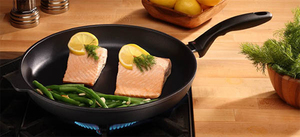
Non-stick pans are only really suitable for cooking at low to medium temperatures, such as frying eggs, searing fish, making pancakes, or gently stir-frying vegetables.
Solution: If you need to sear a steak at high heat, use a cast iron or stainless steel pan. Use a non-stick pan as intended, cooking at moderate heat.
Friction from metal tools
A readily identifiable mechanical mistake is using aluminum or stainless steel spoons, spatulas, chopsticks, or spatulas that rub directly against the pan's surface. The hardness of metal is far greater than that of the delicate polymer coating.
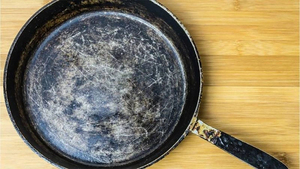
Just a vigorous stirring of food or scraping the burnt layer from the bottom of the pan with a spoon is enough to create microscopic scratches. These scratches not only detract from the aesthetics and negate the non-stick properties of that area, but also create gaps for oil, grease, and salt to seep down and corrode the aluminum core inside.
Furthermore, when the non-stick coating is scratched or torn, microplastic fragments can break off and mix into the food.
Solution: The essential utensils for non-stick pans should be made of wood, bamboo, or heat-resistant silicone. These materials have an elastic and soft structure, providing excellent protection for the pan's surface.
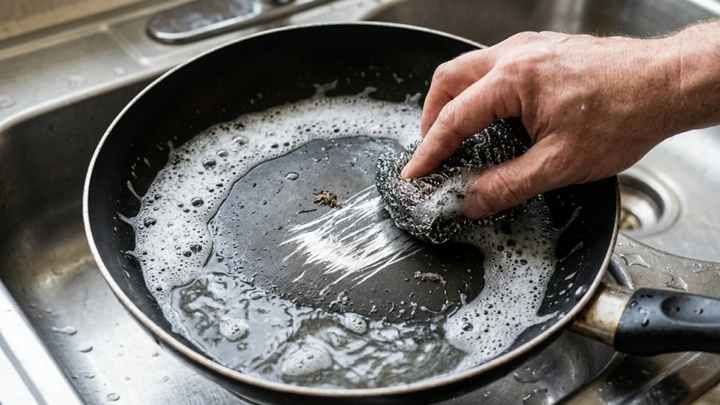
Using a metal scouring pad will quickly damage non-stick pans. (Image: HTC)
Washing with scouring pads and the habit of stacking pots and pans.
Absolutely do not use aluminum scouring pads or the hard, abrasive side of a dishwashing sponge to scrub the pan. It's no different than sandpaper, stripping away the non-stick coating. Similarly, experts advise against putting pans in the dishwasher, as the strong alkaline detergents and the hot water pressure will dull and erode the pan's surface over time.
Because kitchen space is limited, many families often stack pots and pans on top of each other. The sharp metal bottom of the pot on top will directly rub against and scratch the non-stick surface of the pan underneath.
Solution: Wash the pan by hand with a soft sponge. If there are burnt-on stains, soak the pan in warm water with a little dish soap for 15 minutes, and the stains will come off on their own.
When storing, hang the pans on hooks, or if stacking is unavoidable, place a thick paper towel or specialized felt pad between the layers.
 Comment