


 Hotline: 0855.911.911
  RSS
RSS 





The 15th day of the fourth lunar month each year is the anniversary of the birth of the Buddha (Buddha's Birthday).
Where was the Buddha born?
Many people still believe that the Buddha was born in India. Is this true?
The Buddha was originally the prince of King Suddhodana, the ruler of the Shakya kingdom located on the border of present-day India and Nepal, with its capital in Kapilavastu. His mother was Queen Maya. Shakya was a vassal state under the influence of Kosala (one of the 16 largest kingdoms among hundreds of smaller kingdoms on the ancient Indian peninsula).
So where is the kingdom of King Suddhodana located on a modern map? Many archaeologists identify the city of Kapilavastu as being in the village of Tilaurakot, in the Kapilavastu district of present-day Nepal. Others suggest it was located in the village of Piprahwa, in the Siddharth Nagar district of Uttar Pradesh, India today. Both sites contain numerous archaeological remains dating back to the time of the Buddha.
According to some scholars, the Shakya kingdom's territory may have encompassed both locations. However, the majority of scholars support the view that the ancient city of Kapilavastu was located in Nepal.
Lumbini, believed to be the birthplace of Buddha, is a popular pilgrimage site located in Rupandehi district, province 5 of Nepal.
How was the Buddha born?
Queen Maya, wife of King Suddhodana, was also his cousin. They had been married for 20 years without children. According to legend, on a full moon night, the queen dreamed that four angels carried her to Lake Anotatta in the Himalayas. She bathed in the lake and the angels dressed her in celestial garments, anointed her with fragrant oils, and adorned her with beautiful flowers.
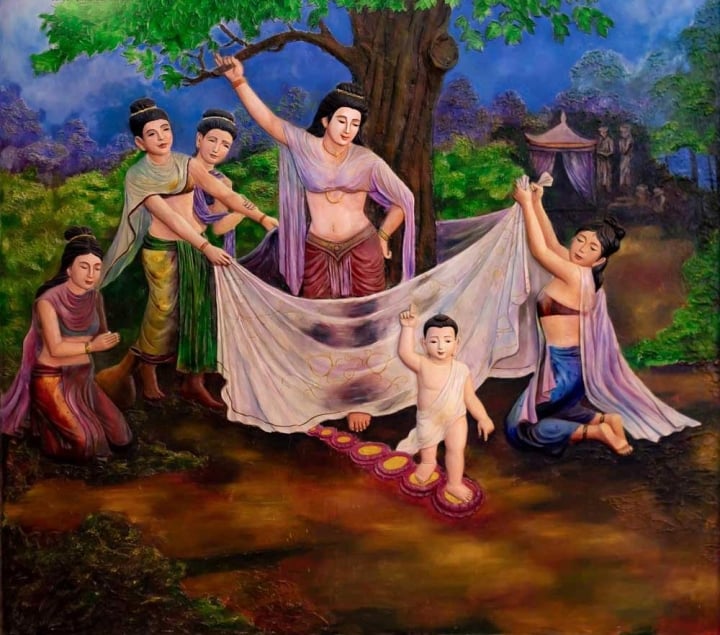
According to Buddhist legends, the Buddha was born under a sala tree and could walk and talk immediately after birth.
Then, a white elephant (a sacred symbol to ancient Indians) used its trunk to lift a white lotus flower, circled the queen three times, entered her womb, and disappeared. From that day on, the queen was pregnant.
After ten months of pregnancy, nearing her due date (believed to be in 624 or 563 BC), according to custom, Queen Maya had to return to her maternal home in the small kingdom of Kolia to give birth. On the way, she stopped her palanquin and walked under the shade of a sala tree in the Lumbini garden. Labor pains arose, and she gave birth to Prince Siddhartha (meaning "fulfilled") there, while leaning against a sala branch. Legend says the child emerged from his mother's right side at dawn on the 8th day of the fourth lunar month (according to Mahayana Buddhism) or on the full moon day of Vesak (according to Theravada Buddhism).
Some legends also say that the queen bathed her newborn son in a nearby pond. Another legend tells that the gods created the rain to bathe the young prince.
Legend has it that when the Buddha was born, he walked seven steps in meditation, and a lotus flower bloomed under each step. At the seventh step, he stopped, pointed one hand to the sky, and the other to the earth, declaring: "Above and below heaven, I alone am supreme."
Seven days after giving birth, Queen Maya passed away. Her younger sister married King Suddhodana and took over raising the prince. To devote herself entirely to her deceased sister's son, she entrusted her own son, Nanda, to a wet nurse.
Strange occurrences during the Buddha's childhood.
According to Buddhist scriptures, when the crown prince of King Suddhodana was born, the famous ascetic Asita requested a visit. The king ordered his son to be brought out to pay homage to the ascetic, but unexpectedly, the child spontaneously turned towards Asita and placed his feet on his head. The ascetic, who was sitting on a chair, quickly rose, clasped his hands in greeting to the prince, and prophesied that this child would later become the greatest and most noble person in humankind. Hearing this, the king also bowed in greeting to his son.
Then the hermit burst into tears, alternating between crying and laughing. When asked why, he said he was happy that the prince would one day attain Buddhahood, and he wept because he knew he wouldn't live to see that day and receive teachings from the Buddha.
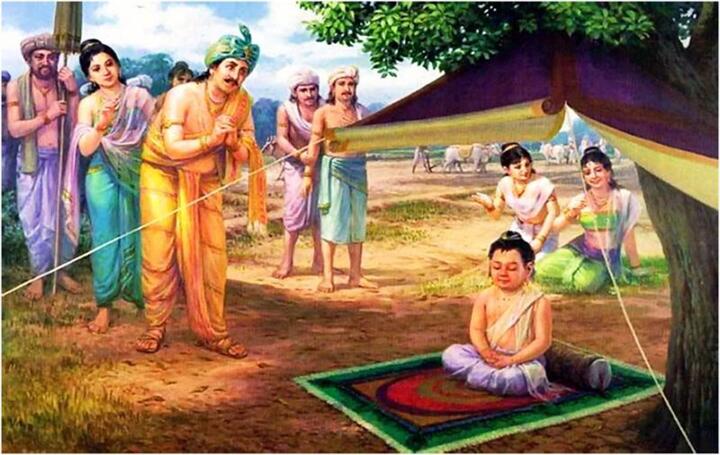
The painting depicts King Suddhodana paying homage to his son during the rice planting festival.
One day, during the harvest festival, the king and his courtiers, dressed in their finest clothes, went to the place of worship. The young Prince Siddhattha was also placed in a palanquin by the palace maids, under the shade of a tall tree. Seeing everyone happily watching the ceremony, the palace maids attending the prince also ran to see. There, in the quiet shade of the tree, Siddhattha sat cross-legged in the lotus position, intently observing his breath… and attained the first Jhana. The palace maids remembered their duty, turned back, saw this, and reported it to the king. King Suddhodana approached the meditating prince, bowed, and said: "My dear son, this is the second time your father has bowed to you.".
Many years later, King Suddhodana paid his third homage to his son, when Prince Siddhartha had attained enlightenment, become the Buddha, and returned to visit his family.

 Comment