


 Hotline: 0855.911.911
  RSS
RSS 





The DART mission rocket, which lifted off from Earth on the afternoon of November 24th (Vietnam time), had a simple mission: to collide with an asteroid at a speed of approximately 24.000 km/h (15.000 miles per hour).
This experiment aims to test whether an asteroid struck by a spacecraft can have its orbit altered. If successful, the mission would be very useful for NASA and other space agencies when needing to deflect an asteroid, thereby eliminating the possibility of a catastrophic collision with Earth.
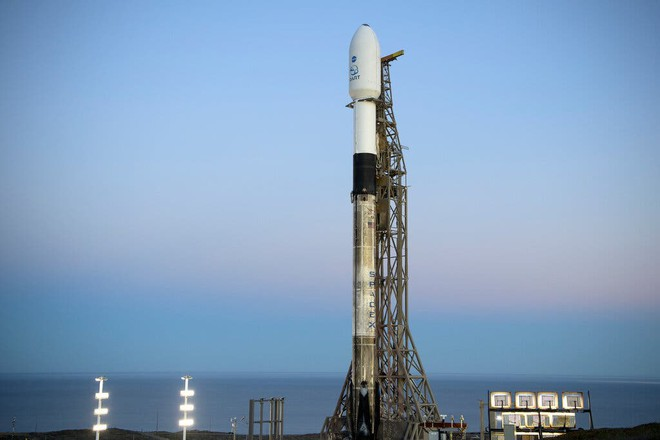
The DART spacecraft will be launched into space aboard SpaceX's Falcon 9 rocket. (Image: NASA)
According to NASA Administrator Bill Nelson, it's conceivable that DART (Dual Planetary Interchange Experiment) would function like in a movie scenario. Armageddon, even though that film is entirely fictional.
After launch, the spacecraft will complete nearly one orbit around the Sun before encountering Dimorphos, a moon of a larger asteroid called Didymos. Dimorphos is not a threat to Earth; it was chosen simply as a target for the mission.
The DART collision is expected to occur in late September or early October 2022, when the asteroids are at their closest point to Earth, approximately 11 million kilometers away.
Four hours before the explosion, the DART spacecraft will automatically steer itself straight toward Dimorphos for a head-on collision at a speed of 24.000 km/h.
An onboard camera will capture and send images back to Earth in real time about 20 seconds before impact. Another small satellite from the Italian Space Agency, deployed 10 days before impact, will approach within 55 km of the asteroid to take snapshots every 6 seconds, capturing the moments before and after the event.
To assess whether DART will alter Dimorphos's orbit around Didymos, astronomers will monitor the asteroid's reflection of sunlight over time.
If Dimorphos' orbit extends for at least another 73 seconds, DART will prove its mission a success. But operators hope the collision will extend the asteroid's orbit for another 10-20 minutes.
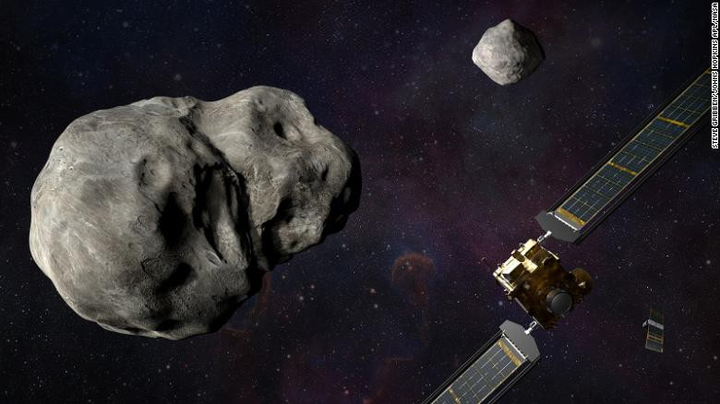
This image illustrates the DART spacecraft before its collision with the asteroid. (Photo: NASA)
Previously, many engineers and experts conducted simulations using nuclear weapons to alter the orbit of space objects. This is also one of the few weapons NASA has for planetary defense.
However, if not operated correctly, a collision between an asteroid and a nuclear weapon could create a large amount of debris, exponentially increasing the danger.
According to Brent Barbee, an aerospace engineer at NASA, the DART mission “has the potential to do a pretty good job” with any small, distant asteroid that might threaten Earth in the coming decades.
"But if the asteroid is larger or the warning time is shorter, that's when you shift your consideration of the kinetic impact to nuclear devices.", Barbee said.
However, using nuclear weapons in space is not easy. Treaties prohibiting the use of nuclear weapons and the Outer Space Treaty, the foundation of international space law signed in the 1960s, prohibit the deployment or use of nuclear weapons in space.
 Comment