


 Hotline: 0855.911.911
  RSS
RSS 





According to the Ministry of Natural Resources and Environment, in the four years from 2019 to 2023, the amount of waste processed by landfilling nationwide decreased by 6%, which is a positive sign.
According to the head of the Environmental Pollution Control Department (Ministry of Natural Resources and Environment), the amount of solid waste generated in Vietnam is currently about 67.000 tons per day. Of this, urban areas account for 60%, with the two major cities of Hanoi and Ho Chi Minh City alone generating 7.000-9.000 tons of household waste daily.
The current collection rate is 95% in urban areas and 71% in rural areas.
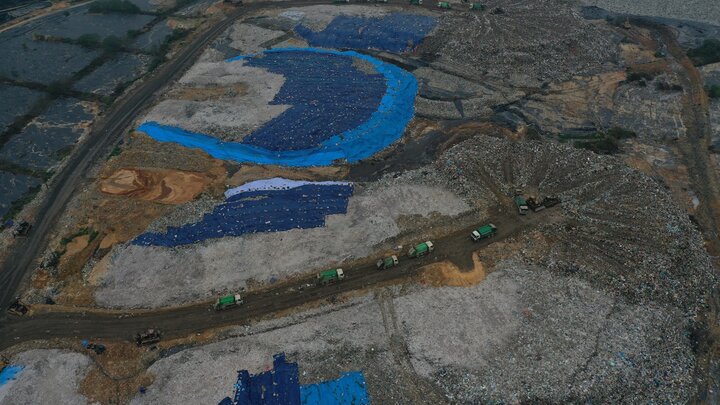
Nam Son landfill in Hanoi (Illustrative image: Huy Manh)
Nationwide, there are over 1.700 facilities for processing municipal solid waste, including 470 incinerators and more than 1.200 landfills. Three large waste-to-energy plants are currently operating: the Soc Son waste-to-energy plant with a capacity of 4.000 tons per day, a plant in Can Tho with a capacity of 400 tons, and a plant in Bac Ninh with a capacity of 180 tons.
According to the head of the Environmental Pollution Control Department, the amount of waste treated by incineration increased by 7% in 2023. Waste treatment through incineration for power generation and gasification is expected to increase further in the coming years, as 15 waste incineration plants are currently under construction.
"Increasing the amount of waste burned will reduce the pressure of soil and water pollution on local areas.""A representative from the Environmental Pollution Control Department said, adding that although the amount of waste buried in landfills has decreased, it remains at a high level, and some shortcomings still need to be addressed."
Dozens of private and state-owned enterprises are involved in waste collection and treatment, but their capabilities are uneven and still have many limitations and weaknesses.
The waste collection vehicles used by businesses are inadequate, and there is a lack of transfer stations for recycling, sorting, and processing waste. Some localities are struggling to choose waste treatment technologies, using outdated technologies that do not meet requirements.
The implementation of waste treatment projects using modern technology is slow. The planning of locations for waste treatment plants faces opposition from local residents.
Leaders of the Ministry of Natural Resources and Environment shared that they are mobilizing all resources to handle household solid waste by reducing budget support, applying service fees, and gradually adjusting prices to compensate for collection and processing costs.
In 2024, the entire natural resources and environment sector aims to improve environmental component indicators, with over 92% of operating industrial parks and export processing zones having centralized wastewater treatment systems.
At the same time, the Ministry also determined that 95% of urban household solid waste will be collected and processed in accordance with standards and regulations, and 40% of household waste will be processed using incineration, electricity generation, and recycling models instead of landfilling.


 Comment