


 Hotline: 0855.911.911
  RSS
RSS 





The goal of achieving double-digit economic growth is being set as a strategic requirement for Vietnam in this new phase of development.
To realize this goal, in addition to traditional drivers such as exports, investment, and consumption, a strong contribution from key state-owned economic groups is needed, especially Petrovietnam - an enterprise that plays a crucial role in ensuring energy security, developing foundational industries, and generating revenue for the national budget.
Petrovietnam is not simply an oil and gas exploration and production company. The corporation has developed into a relatively complete industrial-energy ecosystem, encompassing oil and gas exploration and production, gas industry, petrochemicals, power generation, oil and gas technical services, and more recently, new energy sectors.
With its large asset base, significant annual revenue share in GDP, and leading contributions to the national budget, every development of Petrovietnam has a ripple effect on many other economic sectors.

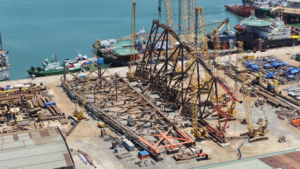
The White Lion oil and gas condensate platform is located within the White Lion field cluster.
In the context of an economy aiming for higher growth rates, Petrovietnam's primary role is to ensure a stable energy supply for production and daily life. In reality, economic growth and the growth in energy demand are always closely related.
With major hydropower resources nearing their full potential, many coal-fired power plants face environmental pressures, and fuel sources such as natural gas and new energy forms are becoming important options for the transition period. This is precisely the area where Petrovietnam has a significant advantage and superior capabilities.
Accelerating the progress of key projects such as the Lot B - O Mon gas-electricity chain and LNG infrastructure projects not only helps supplement energy sources for the economy but also creates momentum for investment growth, the development of supporting industries, and attracts social capital.
Each large-scale oil and gas project typically involves hundreds of businesses in the construction, engineering, transportation, finance, and technical services sectors, thereby creating widespread spillover effects.
Another aspect that cannot be overlooked is Petrovietnam's role in ensuring national energy security. In the context of a volatile global energy market due to geopolitical conflicts, strategic competition, and the global energy transition, proactively securing domestic supply is of particular importance.
Energy security is not just about having enough electricity or fuel; it is also a prerequisite for maintaining sustainable economic growth and enhancing national competitiveness.
From this perspective, Petrovietnam is demonstrating a pioneering role with its transformation into new fields such as LNG, gas-fired power, hydrogen, and renewable energy... Early participation in these fields not only helps diversify operations but also enables the corporation to play a leading role in the formation of integrated multi-energy models.
The Politburo's Conclusion No. 76-KL/TW dated April 24, 2024, on the implementation of Resolution No. 41; the Politburo's Resolution No. 70-NQ/TW dated August 20, 2025, on ensuring national energy security until 2030, with a vision to 2045… or the decision to rename it the Vietnam National Energy Industry Group have opened up new opportunities for the group to participate more deeply in fields such as offshore wind power, green hydrogen production, carbon capture and storage (CCS/CCUS), as well as developing marine energy value chains.
This is not only a requirement to adapt to global trends but also an opportunity to create new growth drivers for the economy in the future.
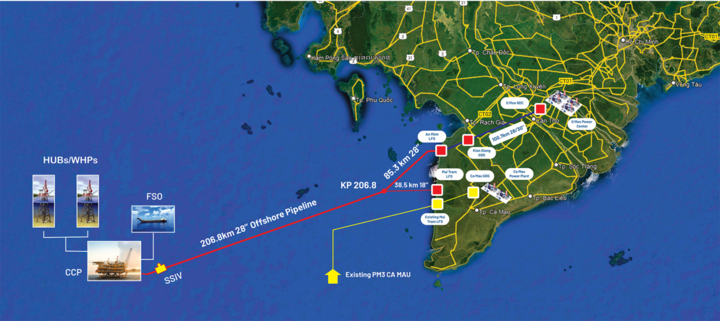
The Block B – O Mon Gas-Power Project Chain.
According to Dr. Vo Tri Thanh, Director of the Institute for Brand and Competition Strategy Research, in the period 2026-2030, Petrovietnam should be seen as a "force accompanying nation-building." This means the Group needs to assert its role even more in proactively participating in building and perfecting policies and institutions.
“Improving the quality of institutions in the energy and foundational industries will help unlock resources that are currently hampered. Petrovietnam, with its international management experience, has the responsibility to lead other Vietnamese businesses in keeping pace with the digitalization and greening trends.”"That's what Dr. Vo Tri Thanh said."
Sharing this view, Dr. Le Xuan Nghia, Director of the Institute for Development Consulting, stated: With revenue accounting for approximately 9-10% of GDP, Petrovietnam's growth is crucial to achieving the high growth target of the national economy.
Therefore, he pointed out that human resources and talent are the most valuable resources for Petrovietnam to master technology and achieve breakthroughs, creating a solid foundation for the nation's double-digit growth target.
However, for Petrovietnam to fully realize its role, it needs to continue improving mechanisms and policies in a way that empowers the enterprise to be more proactive in investing, managing, and implementing strategic projects.
The oil and gas industry is characterized by long investment cycles, high risks, and a need for quick decisions. If procedural bottlenecks, financial mechanisms, and investment obstacles are not removed in a timely manner, many development opportunities may be missed.
Vietnam's double-digit growth target requires the synergy of many new and existing drivers. In this context, Petrovietnam is not only a large state-owned enterprise but also a pillar of energy security, an industrial powerhouse, and a crucial force in the green transformation process.
Effectively harnessing Petrovietnam's potential means creating a powerful impetus for the economy to break through, enhance its resilience to external fluctuations, and move towards rapid growth while ensuring long-term sustainability.
 Comment